“The Second Mountain” is a book that describes the journey of someone spending a lifetime reaching the peak of a career, and then finding this “mountain” is in fact hollow and empty and no longer interesting. And seeing in the distance a “second mountain” that is golden and exciting and worth moving on to. I no longer practice antitrust, after 25+ years of involvement in the main issues & battles & cases in Europe and elsewhere. Nothing to prove, done that, bored, now doing other “mission things” I find much more exciting and useful for Europe. BUT I still have a “rearview mirror” interest in something I spent a lifetime doing, and should matter somewhat – even though at times it seems to do its best to become irrelevant. Events like new “Merger Guidelines” being rewritten after 20 years are milestones and should be a weathervane, an opportunity to take stock of where we are and what we are doing. In this spirit, earlier this week we held a webinar at the CEPR Competition Policy Research Network on Straight Talk: Draft New Merger Guidelines vs “Competitiveness” Mission.
Speakers were the entire RPN Steering Committee, because we are (nearly) all old hands at competition (and competitiveness) and for a change we thought it would be good to have a no-holds-barred debate among us friends, without regulators having to defend the institutional line, and say it like it is: Tommaso Valletti, Tomaso Duso, Florian Ederer, Sander Tordoir and me (no conflicts or commercial interests for anyone). The discussion was as expected – lively and with lots of healthy disagreement. Sander as an “outsider” to the Bubble brought especially fresh perspectives we all appreciated. We have different views, all sincerely held and reflecting our own (hopefully coherent) respective worldviews, on what these Merger Guidelines should accomplish and the role of competition policy in Europe at this point. All good. I will attempt to summarise below and aim to do it justice – of course judge for yourselves by watching the recording, or reading the transcript at the same site.
What we all agreed on is that the current Draft Guidelines are nothing much new, essentially a codification of established merger practice of the last 10 years. We have been doing just this. The old Guidelines of 2004-08 were out of date and daily practice had moved on (we have been doing dynamic effects and loss of innovation competition for ages). “Theories of benefit” and “Innovation Shield” being the main new things, though none of us was very positive on either (see below). Friendly disagreement on much of the rest.
My own starting point was that Europe is in massive turmoil: Draghi analysis squared, China 2.0 majorly threatening our industrial core and entering the AI transformation as a total colony in tech (this diagnosis was also more or less shared by the group). Why did President Von der Leyen invite a review of merger policy – hence of these guidelines? The general interpretation is it was driven by corporate interests across Europe and a mistaken view that “need for scale” (cfr. Draghi) just means laxer merger control to favour European incumbents (in telcos etc.). And as such DG Comp is right to resist it. My view is:
- If we are going to produce new Guidelines, this should be an opportunity for thinking hard about what competition policy should be doing, working together with other economic policy tools. Codifying current practice IS in fact a statement, just not one I personally see as useful. It is saying “we have been doing things just right for the past 10 years anyway”; or “we do not need to do anything different” because we are getting it right in our practice today. There is a single solitary mention in paragraph 10 “the global political and trade context has changed”, a perfunctory principled discussion of “scale vs market power” in paras 11-15, the rest is a (competent) writeup of current practice. Could have been written 10 years ago, 5 years ago.
- I think scale matters, and while of course we must protect European small firms and innovators and defend from entrenched incumbency (I created EuroStack with that very mission in tech) there are key strategic sectors where I think we need to literally do “whatever it takes” to allow for European muscle to be created: defence, semiconductors, satellite communications, aerospace. Does this mean laxer merger control? Not generally, and not really. Bear with me a second.
- Of course creating industrial muscle requires a host of other policies – industrial policy, trade defences. As we heard many times during the discussion, “competition policy let alone merger policy cannot solve the competitiveness problem” – yes, absolutely.
- What’s more, my own view from 25 years of actually doing mergers is that merger control is often a fudge, very little gets blocked and there is a lot of “remedies theatre” – most remedied cases do not do anything to “preserve market structure and competition”. I can quote literally countless examples. So again I do not think merger policy in general is too strict and should become laxer at this point. In fact, merger control does very little that matters to market structure.
- But that said, I think we need to absolutely create “European champions” in key sectors and if this involves mergers in these strategic sectors, have at it. For instance I do not begin to see why the Airbus/Thales/Leonardo review in Brussels is taking so long (no involvement, just asking). I am sure I can think of countless theories of harm. But don’t really care at this point.
- This is not favouring laxer merger control in general. It is merger policy being awake to European realities. I have done the Brandeisian line that antitrust is good for democracy before it was fashionable. This was then, Europe 2026 is in a different – dramatic – place. Personally I think we are in a totally different predicament and competition/merger policy cannot be invariant to context.
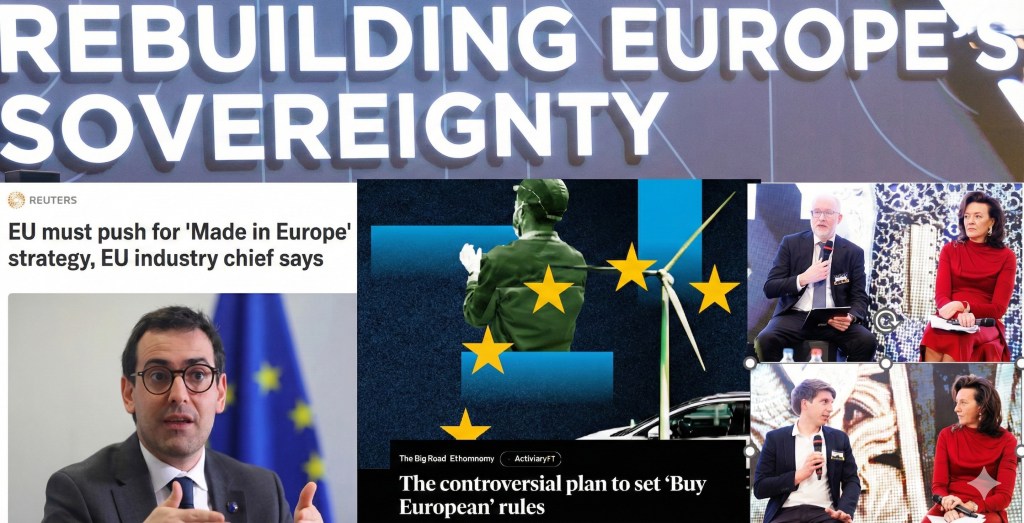
- Finally, yes it’s good to say “let competition policy do its thing and work together with other tools”. But it DOESN’T. Competition and trade and industrial policy are still very siloed. An example I gave (not mergers) in the event is “Buy European”: important for digital sovereignty, for IAA in base sectors, opposed by entrenched interests weaponizing competition arguments: “Buy European is discriminatory and as such anticompetitive! Will take you to Luxembourg!”. Yet no one at DG Comp comes out to say “knock it off, it’s not anticompetitive at all”. So the position that “competition/ merger policy cannot solve the competitiveness problems, it should pursue competition” is not satisfactory to me. The review was triggered by “Europe is in serious trouble, all hands on deck”; an answer that de facto says “we are already doing everything right,” “competition not only delivers lower prices but stimulates greater productivity investment and innovation” – is to me motherhood and apple pie. Who needs to hear it. Let’s do better. Amen.
Now let me try and do justice to others’ views, which of course are genuinely held by very thoughtful friends. There is value and valour in much of this, though I believe there is also room for a different position.
Tommaso and Tomaso and Florian shared the view that in the end these are just “merger guidelines”, and as such should not be expected to do much more than setting out principles and a coherent methodological framework for review as practiced by DG Comp today – useful for practitioners and courts. More generally there was a common strong thread that “competition” is the goal, because it protects and generates a lot of things we care about: from new entry, to innovation, to competitiveness, to democracy. Let other tools do what it takes for competitiveness (I agree in principle but not enough to me, and the motivation for commissioning a review was certainly not just “codify the status quo”).
Tommaso was especially strong on the point that merger policy is already very lax and has to become much stricter than in the past, which is also good for the competitiveness agenda, productivity and innovation. We need contestability, because monopolists are not innovative, and experimentation because innovation comes from young firms and we should not be obsessed with “bigness”. He emphasised there is a coherent intellectual construct behind this all: “contestability and competition are helpful for Europe, helpful for citizens, for democracy, for sovereignty, for resilience. This is my North Star, we need to protect European firms, European employment, European innovative startups”. Indeed “we have allowed almost everything to go through so far … we have had a relaxed merger regime… we need a very strong injection of competition…including adopting safe harbours for mergers among SMEs and a structural presumption against big firms”. If anything “I would be in favour of drastically changing things in the opposite direction relative to what we have done in the past 25 years.., I am becoming very ordoliberal, I do see value in competition going to the core of European democracy and we need to fight for it”.
Tomaso described “two camps” to “address Europe’s investment and productivity growth deficits that we all agree, are very serious”: “the “scale at all costs” camp, which says need concentration, consolidation, whatever it takes, as the main way to close the investment gap… and another camp that sees competition as a key driver of competitiveness and innovation, and scale as an important part of this, but only pro-competitive scale”. We should not ask more of guidelines than “creating a better analytical framework, and there they are an improvement”. “There are buzzword – resilience, sustainability – which are very important policy objectives, but what do we expect merger control to do with them? … I’m a strong proponent of holistic economic policies that coordinate, but this requires giving clear objective to each tool, and let them talk to each other. The policy objective of merger control is still to protect competition” and should not be widened. If we want to “allow anticompetitive mergers on other grounds” it is possible to do so with accountable political-level decision making. Recognises the “political economy dimension is important”, so “we are talking about the revision of the guidelines in a very politically loaded time, a lot of constraints, and agree we are in a very fast-moving world…what has been done maybe is not fantastic, but was not an easy exercise”. Finally “competition as a driving principle of liberal democracy is something we mustn’t forget. It’s much more than just protecting prices, competition brings innovation, but also constrains power, not only in markets but also political power, and we see it more and more on the other side of the pond”. (As an original purveyor of Brandeisian values in Europe, very much agree in general – but not my focus now).
Florian also thinks “the Merger Guidelines should not be asked to solve Europe’s competitiveness problem, Europe’s problems are much broader than merger control, it’s fragmented markets, capital markets, procurement, energy regulation… none of that gets fixed by letting firms buy rivals. So the job of merger guidelines should be more modest”. Hence “the Guidelines move in the right direction, reflecting what we know about innovation, potential competition, ecosystems and dynamic effects. Codification can matter, especially when the cases go to court, although maybe they don’t go far enough, just codifying what’s been in place for some time”. “The additional problem is they broaden the language more than they discipline the analysis…. danger here that everybody now has a theory of harm and everybody has a theory of benefit, and every acquisition of a startup now comes with a deck explaining why this is great for innovation, why it’s great for scale, why it’s great for resilience, why it’s great for European competitiveness. Sometimes that’s going to be true, but for dominant firms and gatekeepers the default should be much more skeptical”. Finally: “I can see maybe we are not being ambitious enough?… Maybe there’s an opportunity for being more aggressive, to be more creative, … maybe accepting the Guidelines should be about current practice we’re just opening ourselves up to being sidelined by broader political questions, because we’re just constrained by the narrowness of our approach…”
A couple of new things that aren’t that good, actually: Tommaso pushed back on the “Innovation Shield” introduced in the Guidelines – presumably intended as a way of essentially insulating small startups from merger control. “That’s exactly the wrong thing to do”, what matters is not to exempt those deals from review but look at the characteristics of the purchasing firm. If the purchasing firms are American Big Tech it’s “shooting ourselves in the foot, because again, European capabilities, European talent, European intellectual property, and taxes will go elsewhere”. General agreement.
Also not uniform enthusiasm for the novel “theory of benefits”. Yes a common past grouse has been “the Commission does not care about merger efficiencies” and it is good for parties to be allowed to have an upfront discussion of what they say the merger will bring about. Tommaso argued the discussion of “balancing harms and benefits” is too open-ended and pretty empty. It says “we will weigh things which are difficult to compare using discretion”, but this just creates space for incumbents hiring consultants to make up outlandish claims. Tommaso’s own submission in the consultation process looks at the literature on merger efficiencies in actual cases, and shows claims are very thin or not economically meaningful. Broad agreement on this too. Hence this is hardly a game changer from the perspective of European “competitiveness”. Tomaso a little more positive, though also laments the analysis does not seem disciplined. Very vague. I am in the “so what” camp. Will be an opportunity for consultants to make up fantastic stories but a lot of scope for more vacuous submission and discretionary judgments. I don’t think we should indulge this kind of creativity and making up stuff. Personally I prefer to take a sectoral view and say there are sectors in which we can consolidate away, let’s see in 10 years where we are, rather than coming up with some very feeble theory of benefit and do wobbly comparisons with some sort of theory of harm.
Most challenges and fresh views came from Sander – as a rising star in the macro policy debate and not steeped into the Antitrust Bubble. Started from the large macro distortion of the “second China shock”, now top of mind for European leaders. “That speaks to Cristina’s thesis that the world is changing, and it is exceptionally hard for many of our firms to make money in an environment in which their Chinese competitors are often loss making or have very small margins”. Further “Europe has pretty threatening strategic dependencies, be it on China or the US, they tend to emerge from having “too much competition”, driven by state-induced subsidies and distortions”. He pointed to four issues that are not part of the usual discussion of merger control, but important to be cognisant of the challenges:
- Need to be strong in FDI screening and block mergers and takeovers, be it from the US or China, that harm Europe’s long-term interests. A recent NBER paper shows that European firms that are taken over by China do not prosper, in fact they bleed out. We have to be very strict here and use merger control in the form of FDI screening to protect Europe’s sovereignty and long-term productivity;
- Semiconductors: “by far the most profitable sector in the world, lots of monopolies all over the place, scattered around the globe… How do we do policy in that sector? It is not that ambiguous, it’s a sector in which we should not be too afraid of consolidation and concentration in Europe, and I would agree with Cristina’s arguments”;
- “A third sector that’s more difficult to play with is the IAA’s host of energy-intensive and automotive sectors where Europe is trying to put local content requirements into the supply chain for batteries, trains, automotive parts, maybe automotive semiconductors, and “that raises a number of difficult issues. Europe wants to build scale on batteries to keep up with China, but also have a sovereign battery supply chain that is indispensable for drones or automated weapon systems, the arms of the future. This raises difficult questions. If you’re so far behind, do you consolidate the few firms that you have, so they have some scale, they have some profitability to reinvest in innovation, or do you go for a decentralized setup? …We need to think hard about how to interplay that industrial policy push with merger control and competition policy more broadly, and how to balance coordination and competition and consolidation”;
- Hardcore economic security: “take rare earth refining. The entire West has outsourced that to China in 1990. Europe and the US were self-sufficient in the refining of rare earths… How do you rebuild that sector, and how do we think through the competition implications? Not an easy question. It is a very distorted market… Having one or two giants in that space that are European is preferable over settling for the current equilibrium, where China deploys that market as a source of strategic advantage”.
- “Another very difficult sector is defence… not enough innovative young firms that are doing cutting-edge innovation. They exist in Ukraine, not so much on the European mainland. That is one directional pull. There’s another directional pull, which is that we don’t have enough scale, and we need defence firms to consolidate and spread across Europe, such that European governments do not put tiny orders for ammunitions, tanks, aircraft, etc. for their local champion, but instead order with a European champion that can produce at scale and low unit costs. There is a set of tensions there. Do we want that sector to consolidate and create, let’s say, a Rheinmetall that has factories all over Europe, where all European countries buy the same type of kit, so that we go from 120 plus weapon systems to 20, which is where the US is, or do we go for a different set of solutions?”
“These sectoral examples raise some difficult trade-offs on your competition arguments”
Then a couple of provocations too: “What would we do if BYD tried to buy VolksWagen? (not outside the realm of possibilities)”? “What about the Unicredit takeover of Commerz Bank, which Germany is fiercely resisting? Can we see it presenting an opportunity? Few of us are concerned that Europe’s banking sector does not have enough competition. We are overbanked. There are too many players. There’s not enough consolidation. But there should be also a way to think holistically with the sovereignty agenda. Note that JP Morgan has committed a trillion in lending and finance to build economic resilience in the US, including in rare earths and other supply chains. If you’re Berlin, and you can no longer avoid that Commerz Bank will be gobbled up by Unicredit, maybe you say, “We stop resisting Unicredit if you put a JP Morgan style program on the road with funding for our economic security”.
AMEN, again. Much fun debate of these scenarios. Yes it’s not “traditional merger control fare”. But I personally find it hard to accept that “merger guidelines are just merger guidelines” and we can carry on with what we know as IO economists and the IO literature because that is the haegemonic culture in antitrust. I realise I am in a minority probably of one but from the distance of my Second Mountain, I see what Sander is saying as much more relevant and “real” than reaffirming the benefits of “competition” or punting to a broader set of tools we hope will be conversant with each other. This is not to say I do not recognise what others are saying and hold dear as having value. Different perspectives. All good.