

Among so many “bad takes”, let’s go back to base with a restatement of what the most urgent “mission” should be.
Not about “anti-US tech” or “anti-Trump” sentiment
The Trump Administration has shaken Europe awake: nothing will ever be the same again, no going back, the warm sense of security extended for decades by America’s benign protection is over. The resentment accumulated by many in the US (not just a recent MAGA phenomenon) over Europeans (and others) “freeriding on America” translated into a hardline transactional approach where everything is “in play” all at the same time. For us Europeans, used to our siloed approach (trade is WTO trade, regulation is regulation, defence is defence, all separate specialist fields) the result is we appear paralyzed in shock and impotence not knowing how to play multiple games on multiple devices at the same time. The “culture war” aspect of the divide (“risk of civilizational erasure”, “censorship” vs “freedom of speech”) and the fear by European elites this is all a plan to “interfere with our liberal democracies” are feeding hysteria and collective hyperbole – ironically, all entirely playing out on social media outlets owned by the very American tech companies we rage against as threats to our democracy.
But much as the latest events (most recently, travel bans for an ex-Commissioner and four hate speech “trusted flaggers”) are deepening awareness that Europe needs to be less dependent on American tech, resentment and antipathy for tech oligarchs or the Trump Administration are not the motivation for the EuroStack mission. Nor is anti “Big-Tech” sentiment. US tech companies have filled a vacuum Europe left for them to fill over the last 20 years. They rolled forward and dominated the market. Some of their practices are sharp or even outright anticompetitive, but they are otherwise extremely capable and they are here to stay: Europe will simply never be able to replace them altogether. And this creates a persistent dependence and vulnerability to geopolitical vagaries, that we absolutely need to reduce. EuroStack is a mission to expand Europe’s capabilities and assets in tech. As an industrial project, to create alternatives, improve resilience and favour growth. Not an autarky mission. That’s it.
Clearing up the many “bad takes”
Because EuroStack is the most successful and visible tech policy initiative to have come out of Europe in recent times (it gained huge name recognition among diverse groups in less than a year – from politicians to industry to civil society to think tanks to academics) a lot continues to be written about it by external commentators who are not involved in the movement and often regard industry and business as tainted, impure and unethical (as opposed to a “value minded” public sector). These multiple “bad takes” need to be taken up.
One category of “bad takes” comes predictably from astroturfers on Big Tech’s payroll (too many to mention, but for examples see here and here; also for a more subtle take see here): that EuroStack aims to fully replace the entire technology stack in Europe with native alternatives, that this is harmful and will hold Europe back because we don’t have these alternatives, or it would cost a bazillion to do so, and/or the alternative would not only cost more but also be of lower quality. This is a bad take perhaps unwittingly fuelled by the Bertelsmann Report last February which threw out a “300bn Euros” price tag as the investment required to “implement the EuroStack”. This figure has been an unfortunate point of conflagration as industry recoiled from it (“what, how, who is going to invest this money? 300bn sprayed around by the Commission? God help us”) and the hyperscalers’ proxies were gleeful (“see, EVEN EuroStack recognises this is going to cost bazillions! Europe does not have that kind of money! It will all be wasteful duplicative investment! European business will be getting worse products at higher prices!”). This is not the position of the EuroStack Industry Initiative – more on which later.
Another category of bad takes comes from civil society and think tanks, and is predictably ideological and often naive – reflecting lack of business experience and investment savvy, often ideological distrust of business and profits, belief in “public value” rather than “value creation”, misplaced obsession with antimonopoly as our saviour (quod non) and a background in ethics and fundamental rights rather than in “making actual stuff that sells and makes money”. I have eyerolled multiple times in the last few months at a multiplicity of miss-takes on EuroStack. I am not even talking about the bigger discussion out there on “what does sovereignty means” as a concept (disquisitions on the sex of angels), which typically involves admonishment to governments that they must build “European values” and “democratic accountability / governance” into whatever it is they will be doing. I will not indulge the many mind boggling contortions – as I said before I find this discussion tedious and pointless: we are in a time crunch and we must move in a hurry, let’s not waste another three years with white papers, reports and symposia on what embedding true European values and human-first into sovereignty should mean.
I will just mention a few of the specific bad takes around EuroStack. Time is of the essence and we don’t have the luxury to sit around writing papers and debating ad infinitum. These are all distractions, noise and time sinks. By all means, have at it, write papers, talk among yourselves. Don’t suck oxygen out of the room and make endless noise over things that go nowhere. If we need to build solutions we don’t have years to wait for these principled conversations to somehow seep into something. We are talking about products and services. Developing European products and services to serve European demand with adequate performance and price. THIS is the only question we should have armies of business and investors crushing right now in real time.
The first category of problems is the assumption that the main reference and interlocutor in “building the EuroStack” must always be the public sector, by definition. That in fact, digital infrastructure must be (nebulously) public. This reflects an inherent bias we have developed in European civil society and academe where the assumption is always “the Commission” or “the public sector” are the only ones we can rely on to do something “with values” – presumably because they are not tainted by vulgar commercial considerations? “The public sector” must always lead the way. Oh and must be injecting “our unique European values” into an alternative “reimagined” world (the word “reimagining” should just be banned forever).
This is not how the world works. The Commission and the public sector can be in practice useful anchor tenants; can be patient investors in hard-to-fund projects. But they are not makers of the products and services that customers need to buy in order for there to be a tech sector in Europe. If you don’t start from the premise that there must be commercial- grade products actually made by actual firms that make actual money because actual customers buy them, you have lost the entire plot. The public sector has a role to play but it is not the entrepreneur here. Industry must do industry.
Second big theme is the whole discussion around: “Replacing American giants with a EuroStack alternative is not the answer”; “Replacing American Big Tech with European giants will not solve the problem”; “How will we ensure that European alternatives will not have the same issues as American Big Tech?”; “What model of governance will ensure we do not have the same issues for our democracy?”.
I do not know where to start with this. Because it assumes EuroStack (a) would involve a single alternative connected giant “stack” all made up of integrated European alternatives, and/or (b) it assumes we are aiming to build “another Google” or “another Meta”, (c) it assumes such an effort to build equivalent giants would stand the smallest chance of succeeding, (d) it projects “monopoly fears” over a future where no one company in Europe realistically has the slightest chance of developing the degree of market power that remotely justifies antimonopoly concerns. Even in the best rose-tinted scenario, we will remain miles away from that. The main point is: of course we do not want to create extractive data monopolies in Europe blah, BUT we are so far from anything like that ever materialising I don’t know why we are even wasting time with this hypothetical. We are talking about creating more European cloud capacity to serve European customers locally; selling more of our software to European customers; retaining startups in Europe including from our promising AI sector. But the reality is we will remain fairly fragmented whatever we do. No one will begin to have serious market power.
When I read things like “Another Airbus would be pointless unless it was designed as a unique organization with deeply embedded democratic structures and a social purpose”[1]; or “Genuine digital transformation demands more than replacing foreign technology with local equivalents or building new infrastructures on outdated colonial imaginings. It requires radically reimagining the underlying political economy that shapes how digital systems operate and who benefits from them”[2]; or “ “digital sovereignty” and “strategic autonomy” are concepts rooted in nationalistic, militaristic thinking that risk further securitizing essential digital infrastructure. Such framing often leads to nationalistic approaches that can be equally harmful to public interest values” (ibid.); or “while addressing dependencies in the different layers of the tech stack, the EU should also address the democratic deficit and take the lead on tech innovation that is democratic-by-design, not only within the Union, but also globally”[3]; or “With the introduction of the EuroStack, there is a growing risk that state powers over digital borders will extend further. While digital borders are a means to control the movement of people, the EuroStack will result in member states being able to escalate such restrictions into other domains, adding another layer to the digitally fortified state”[4]; and even “it is essential that the EU, in its quest for digital sovereignty, explores alternative ownership models for tech companies and clearly defines their purpose and mission” (ibid) – I think oh boy good luck to us all. Let’s debate all of this pointlessly for 5 years, give grants, organise workshops. While absolutely nothing is happening, god knows what anyone is talking about, industry continues to look the other way mystified, and Europe sinks. The irony is that these same authors charge proposals like EuroStack as “remaining speculative and untested in real-world conditions”. No, sorry, no. This stuff has nothing to do with the real world.
What IS the EuroStack mission?
The EuroStack Industry Initiative does not scratch its collective chin thinking about “governance models” and the like. The starting point for the initiative was the observation that while Europe’s institutions focused over the last few years on a vain effort to “regulate” apps and services, no equivalent effort went into thinking about how this would support the development of a European native digital infrastructure: compute, software connectivity. Will discuss regulation last, but there was a degree of “magical thinking” to the effect that “if we tame Big Tech…” – then what? We suddenly sprout wings? If one asked the question, one had in return vague gesticulation in the direction of “level playing field, reducing barriers to entry” – but building new assets requires a serious combination of a viable business model, prospects of demand, and finance. “Taming the giants” does not build you a business by magic. If you don’t have a business model or enough demand or finance, that’s it. This required focus on BUILDING, not just regulating.
The message is coming loud and clear from many others now, essentially echoing what EuroStack is saying. The head of Belgium’s cyber security, Miguel de Bruycker, just said in an FT interview that “Europe needed to build its own capabilities to strengthen innovation and security”. Further: “EU countries have been fretting about their dependency on US tech companies…” and “De Bruycker says these discussions were often “religious” and lacked focus…”Instead of putting that focus on how to stop the US hyperscalers, maybe we put our energy into building something by ourselves”. AMEN. Imagine we had indeed pursued smart procurement strategies which reserved a portion of public sector demand to “buy European” – instead of wall-to-wall defaulting to American suppliers by the public sector. This is not eccentric or protectionist. It is standard practice everywhere in the world – US giants have been notoriously empowered by smart procurement contracts from the public sector.
Imagine we had tech departments in the public sector manned not just by lawyers but technologists and businessmen with a revolving door approach. This happens elsewhere. Silicon Valley types are often going in and out of government roles in DC. Not in Europe.
Imagine we had real focus on “okay we have regulation but what do we need to BUILD our own stuff”.
Instead, we had hyperbole over regulation (“we will tame them! bicep emojis!”), crashing against the reality that regulation is poorly formulated, cumbersome, slow, highly adversarial – far from being “self enforcing” it is the terrain for guerrilla fights where the targets will spend any amount of money on wily lawyers to keep the wolf from the door. More on regulation at the end.
So Europe has enormous talent, existing products and capabilities in tech. We do not only have ASML, of course, but we also have Silicon Saxony (Dresden) for chips. We have incredible fabless capabilities in Grenoble. We have several cloud companies (not uniform in performance, but several) across Europe. We have tonnes of software production, we are the magicians of Open Source. We have AI companies, we have frontier tech engineering (robotics) and lots of startups. This is all in the private sector. But they are scattered and dispersed across a fragmented market. Faced with the onslaught from US hyperscalers with money and determination, local suppliers shrivelled into a declining share of the market, and startups left for lack of funding. While the public sector bought US tech (“it’s easy, it’s turnkey, it’s plug-and-play, what’s not to love”), and the private sector was also captured (“why not? No one ever got fired for buying IBM”).
That this was our reality became increasingly clear through 2024, and our launch event in the European Parliament in September 2024 put the term “EuroStack” on the map. Serendipitously, also in September 2024 Mario Draghi unveiled his much-awaited report on European Competitiveness, and EuroStack deeply resonated with Draghi’s prognosis that Europe’s economic model is not sustainable, and Europe needs to reduce the widening gap with the US and China in strategic sectors which are key to our future security and prosperity. The tech sector is critical to this broader mission because digital (and now AI) are all-purpose technologies that feed into multiple critical sectors: manufacturing, defence, security.
So the mission was (pre-Trump, note): We need to power up European tech assets and capabilities to offer European customers attractive solutions, to reduce dependence, increase resilience, and to build up Europe’s industrial and strategic assets to raise productivity. That’s it. That’s the tweet. Not “save democracy” or “preserve European values”: this is not the headline mission. Of course, we are Europeans and abide by European rules, which also apply to all in our market – but that’s it. The mission is industrial and commercial because unless that works we are nowhere. Not ideological.
Which is why I am so impatient with discourse around “governance structures” and “monopoly concerns”. This is business. Business needs to make money to invest and grow. Profit is key. European industry is hugely fragmented and no one outside the hyperscalers has any market power. Miles from it. And unless one has market power, we don’t worry about what they do – they can try to do dodgy stuff, competition will cut them down. We worry only (and intervene) if there is market power. That’s the universal rule. European suppliers are so small they won’t be for years in the position of having any market power. So drop all the antimonopoly language you recently learned when it comes to European tech please. Inapt.
The other straw man that gets occasionally trotted out is the argument that “Europeans do not need their own tech, there’s no evidence owning your own tech improves [something or other]”. This is curiously a leitmotiv of Nobel Prize in Economics Paul Krugman, who was so delighted with a recent visit to the Netherlands that he brought back (repeatedly) an old favourite: Europeans should not obsess with their lag position in tech, there’s no evidence it does much good. He acknowledges that “much of the European tech lag may be due to the self-reinforcing advantages of large tech clusters (tech people are more productive when they are located close to other tech people), and tech industries will tend to agglomerate in a few locations – which are now mainly on the American West Coast and in China”. Indeed the numbers show that growth in the rest of the US (North. South, East), lags the West Coast: “For historical reasons California has Silicon Valley and the rest of the US do not”. And indeed productivity rose faster in the West of the US than the rest of the US. So yes, there is an ecosystem effect on productivity of having your own tech clusters. But then he goes on to ask: does this mean that ordinary people’s incomes in the US West increase faster relative to incomes in other regions of the country? The data does not suggest this is the case: “tech-driven higher productivity growth in the West hasn’t translated into an increase in the living standards of the ordinary person living in the West compared to the rest of the United States”. And therefore, while “the US may be outperforming Europe by some measures, living standards for most Americans aren’t rising faster than the living standards of most Europeans” and so Europe mustn’t be chasing tech. Indeed “Europe might count itself fortunate not to be host to tech, which does little to raise most people’s incomes and has helped corrupt U.S. politics”.
Well this is one view. We debunked this take in the episode of my podcast with Rafael Laguna and Dietmar Harhoff: digital (and now AI) are all-purpose technologies and if we improve Europe’s own capabilities along the tech stack, we help “indigenize” technological progress and thread it through our industrial capacity – from defence to energy to manufacturing. And we just need to control at least part of the technology we use over here. That’s it. Sovereignty has value per se.
What does EuroStack actually do?
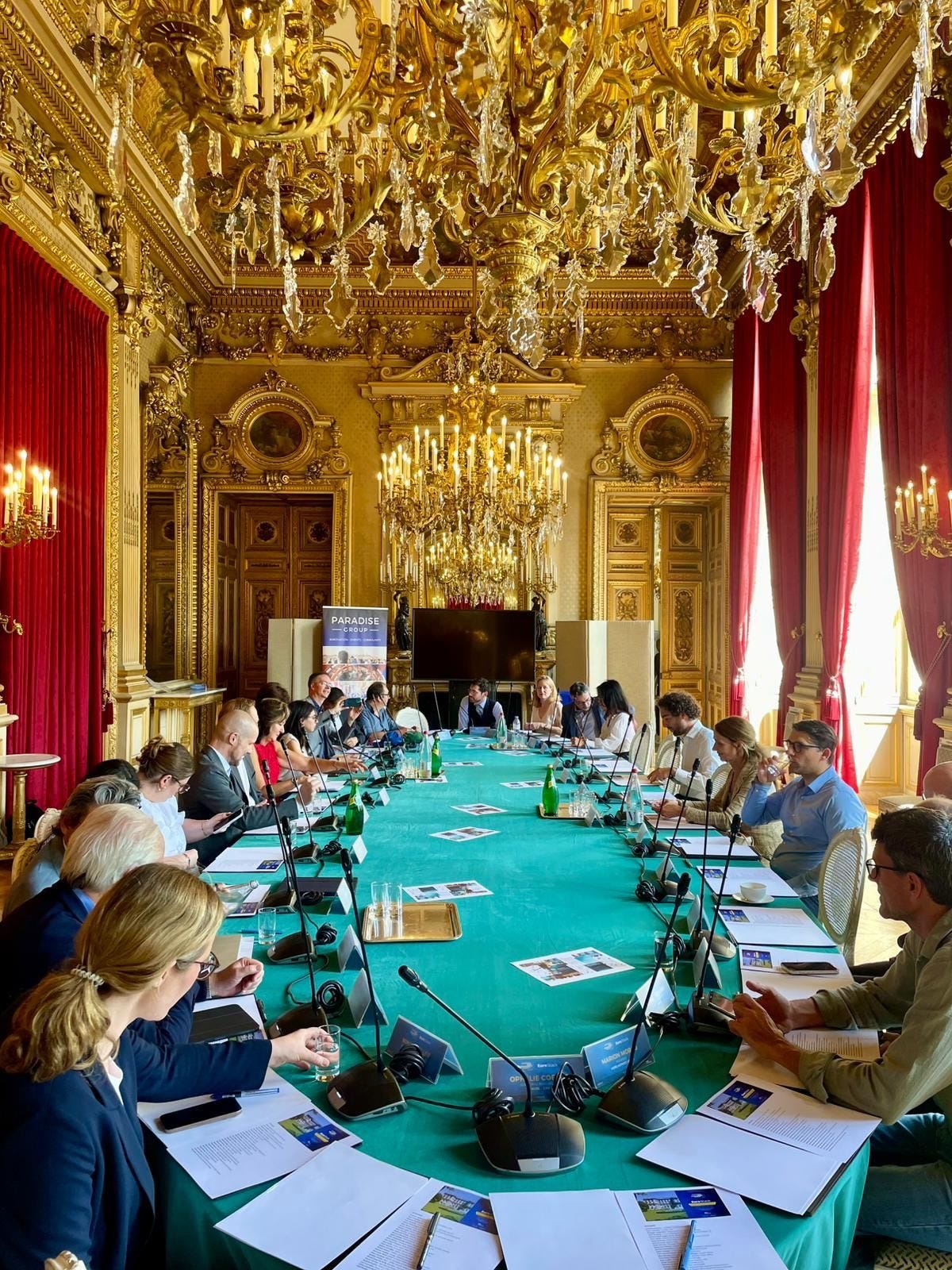
The EuroStack Industry Initiative (now a Foundation) is a volunteer movement of 300+ European tech companies who signed our original letter of March 2025 to EC President von der Leyen and VPs Commissioners Virkkunen and Séjourné on the need to build European capabilities along the tech stack – and remained engaged with the purpose and mission. The group includes a range of businesses – from chips to cloud to software to AI to venture capital.
The initiative is doing (at least) three things – in addition to continuing to proselytise and spread the message:
1. Pushing for a “Buy European” mandate in the procurement of tech services by public bodies. We have campaigned for this from early on, and provided detailed input into the revision of the EC Procurement Directive currently underway (see our Buy European paper of last September); similarly at national level. There is already notable movement to replace American service suppliers in the public sector – most famously the German State of Schleswig-Hollstein has been phasing out Microsoft products for open-source alternatives (Linux, LibreOffice); others in Germany are following, as is the Danish Digital Ministry. There are also homegrown government-generated solutions for the public sector – for instance LaSuite software from France, the OpenDesk software from Germany, and the Dutch government’s amalgamated suite MijnBureau. This is somewhat more controversial as the spirit should be that governments should not become providers themselves, but rather instigators of solutions, and ultimately clients of the final managed solution – not competitors to the private sector providing solutions.
2. But the public sector is not remotely enough. We need to be moving private sector demand towards European solutions. For this, we are liaising with European users to facilitate their shift to European suppliers. This requires customers defining their requirements, and then work by suppliers to match these same requirements – either alone, or creating bundles/integrated offering through various forms of collaborations. This “matching of demand and supply” is the very essence of what is needed to move the dial: suppliers will not enter into spontaneous collaborations to generate composite offerings that meet customers’ requirements – they need specs and a commercial incentive: the prospect of making sales. Scouting these prospects from customers who are interested in shifting at least part of their workloads to European suppliers is important to create proof of concept and kickstart a process of adoption. Note that this is key also to funding: no one needs a “subsidy” mindset, industry does not generally want subsidies to fund development. Funding is available from the private sector if a solution has credible prospects.
3. That said there may be products or collaborations that require development and we are also catalyzing private funds from private offices and other private sources of funding towards EuroStack projects which would benefit from additional funding. As the tide is turning towards “sovereign solutions”, there is considerable interest from funders seeing early profit capture opportunities offered by European tech.
Our focus remains on the private sector because only private enterprise can realistically be trusted to own the relevant technical and business competences to build a viable economic ecosystem. It is rare for governments in Europe to have the tech competences and agility of change of the Digital Ministry of Taiwan under Audrey Tang, a recognised pioneer. Still, the public sector is important to support and amplify (e.g. with smart procurement), but cannot be the one mapping the future of the European tech sector from an ivory tower in Brussels or whatever national capital. Industry and institutions need to collaborate, with industry in the lead.
Other voices pushing for a EuroStack from other constituencies are of course welcome, but no civil society or think tank collective is going to build an industry without business in the lead.
A coda on regulation
The mistake Europe has made is to put all its eggs in the basket of digital regulation, instead of building. This is not to say that regulation is bad nor (as many Big Tech proxies are paid to say) that European regulation is responsible for an oppressive antibusiness environment which stifles innovation and entrepreneurship. The reason we lag behind the US in dynamism and innovation has to do with a range of structural weaknesses Europe is well known for – it is not just “because of regulation”.
That said, my own personal perspective is shaped by my direct experience of multiple years as antitrust advisor to agencies and companies, including some of the targets. Those without direct experience of the antitrust and regulatory process tend to have a romanticized view of regulation as “the law” which needs to be “enforced”, and then all sorts of benign outcomes (competition, a whole new range of alternatives) will inevitably and directly follow from there. The hegemony of lawyers in the Brussels bubble does not help at all in this, in fact they are a bit of a nuisance: they are vocal, they don’t really understand business and seem to just care for “the rule of law” (in the worst cases, because they are advising complainants or making money pushing damage cases).
The brutal reality on the ground, at the coalface, is that “the law” is typically made of vague language, often poorly formulated by non-tech people – which creates endless opportunities for exploiting ambiguities and holes when put to the test of tech people and their expensive lawyers. This in turn creates further endless opportunities for uncertainty and delays in “compliance” with a perception the regulator is “constantly moving the goalposts” while the target is only ever dragging their feet and therefore “maliciously complying”. The process is highly adversarial, deadlines are long and practically ever extensible, due process requires that decisions can be challenged every step of the way. Forever.
To cut a very long story short, we know the GDPR has never been properly enforced and it will not be (see the endless pleas and legal actions by Johnny Ryan and Max Schrems, for years – heroic efforts but nothing ever moves). I was an early supporter of “integrating antitrust and data protection” (see also here), led the effort against Google/Fitbit, but the European Commission did not want to know (in effect “we do competition over here, data protection is over there – don’t call us we’ll call you”).
The DMA has so far generated a fine to Apple over its anti-steering rules which incidentally was the whole focus of an earlier antitrust case concluded in 2024, which lasted 8 years – ending up with a fine but nothing much else on the ground: Commission fines Apple (and for the curious, the reason the DMA had to “go over the same stuff again” was that the antitrust case was only about music streaming (based on the Spotify complaint) and as the Commission defined the market as indeed “music streaming” the remedies did not extend more broadly – Apple made sure of that. This is how ridiculous antitrust is). Another DMA fine has been for Meta on its “pay or consent” model. Both fines/cases are under appeal but they are hardly transformative issues. A Google self-preferencing matter is still under investigation and Apple is known to be settling other issues. That’s it.
The DSA so far only fined X a modest sum over something no one cares about (the “blue tick”) and access to data by researchers. Modest results so far, and of course everyone knows that further action (for what it’s worth) will be further slow-walked and kicked into the long grass not to upset the Trump Administration.
My personal view (again, this is my own and does not necessarily represent the views of others in the EuroStack Industry Initiative) is therefore that digital regulation is not a hill for Europe to die on – and I find the usual self-righteous appeal to “we enforce our rule of law as it is the very essence of our sovereignty” very tedious. If, as I have explained many times, the law is not designed to move the dial much in the first place (see also this and this), and in practice does even less because enforcement is weak, do we need to die so theatrically on that hill? Again, take it in: the results are totally modest, and do next to nothing to grow European businesses. Our energy, focus, effort should be ALL on BUILDING. By all means carry on regulating, don’t give up, but don’t let it take up all the oxygen and energy in the room. Don’t let social media have a breakdown each time the US Administration calls it out. Stop the invectives about bad actors, the “fascist” stuff – as Julius Krein said again in my podcast, “no one cares”. Europe needs a major shift to “build mode”, and this is now or never.
[1] Salvaging European Technological Sovereignty in a Trump 2.0 World | TechPolicy.Press 5 Feb 2025.
[2] Clouds Over Public Infrastructure: Rethinking Internet Governance in the Hyperscaler Era | TechPolicy.Press, 17 April 2025
[3] If Europe Wants Digital Sovereignty, It Must Reinvent Who Owns Tech | TechPolicy.Press, Nov 18 2025
[4] EuroStack’s Digital Sovereignty Push Risks Excluding People on the Move | TechPolicy.Press, 25 April 2025


 The “Post-Bubble” Blog