
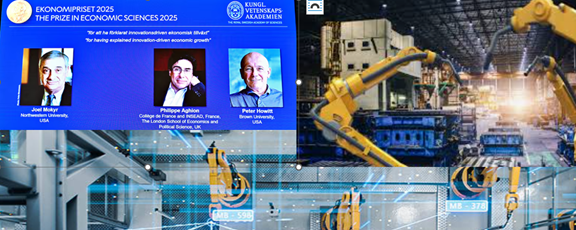
This piece originates from a request by ProMarket to contribute to a forthcoming online symposium on the question: “Does a Globalized Economy Require Big Business?”. The idea was to reflect on antitrust policy developments in the US and Europe on approaches to concentration, consolidation and national champions, in light of the imperative of “competitiveness” on the global stage. The award of the 2025 Nobel Prize for Economics to Philippe Aghion starkly reinforces the message of Mario Draghi in his call for action to Europe: in the current geoeconomics Europe needs serious industrial policy – and competition policy must evolve.
“𝗜𝗻 𝗘𝘂𝗿𝗼𝗽𝗲, 𝗶𝗻 𝘁𝗵𝗲 𝗻𝗮𝗺𝗲 𝗼𝗳 𝗰𝗼𝗺𝗽𝗲𝘁𝗶𝘁𝗶𝗼𝗻 𝗽𝗼𝗹𝗶𝗰𝘆 𝘄𝗲 𝗯𝗲𝗰𝗮𝗺𝗲 𝘃𝗲𝗿𝘆 𝗮𝗻𝘁𝗶 𝗮𝗻𝘆 𝗳𝗼𝗿𝗺 𝗼𝗳 𝗶𝗻𝗱𝘂𝘀𝘁𝗿𝗶𝗮𝗹 𝗽𝗼𝗹𝗶𝗰𝘆. 𝗜 𝘁𝗵𝗶𝗻𝗸 𝘄𝗲 𝗻𝗲𝗲𝗱 𝘁𝗼 𝗲𝘃𝗼𝗹𝘃𝗲 𝗼𝗻 𝘁𝗵𝗮𝘁 𝗮𝗻𝗱 𝗳𝗶𝗻𝗱 𝘄𝗮𝘆𝘀 𝘁𝗼 𝗿𝗲𝗰𝗼𝗻𝗰𝗶𝗹𝗲 𝗶𝗻𝗱𝘂𝘀𝘁𝗿𝗶𝗮𝗹 𝗽𝗼𝗹𝗶𝗰𝘆 𝗶𝗻 𝗮𝗿𝗲𝗮𝘀 𝗹𝗶𝗸𝗲 𝗱𝗲𝗳𝗲𝗻𝘀𝗲, 𝗰𝗹𝗶𝗺𝗮𝘁𝗲, 𝗔𝗜, 𝗯𝗶𝗼𝘁𝗲𝗰𝗵.” (Philippe Aghion, 13 October 2025).
“No Antimonopoly, we are Europeans”
At my conference nearly two years ago we imagined the possibility of a “New World Order”: a progressive “post-neoliberal” vision radiating outwards from the US, where “antimonopoly” had been rediscovered as a golden tool with profound historical roots, to be adopted around the world. The strong antimonopoly revival of the Brandeisian movement[1] regarded concentrated corporate power as the source of many societal harms, which must be dispersed. That aspiration became the lens through which all areas of US economic policy were looked at during the Biden Administration (from trade to industrial policy to finance to transport to agriculture), as part of a progressive agenda centred around “citizens” (workers, small businesses, farmers) instead of just “consumers”. In that view, antimonopoly had a major proactive role to prevent the further concentration of markets (and where possible, de-centralise them) through antitrust enforcement and rulemaking; through industrial policy which did not create national champions; through trade policies that did not carry water for monopolists abroad; through finance, banking, agriculture and transport policies focused on addressing the problems of concentration.
Notwithstanding multiple recent attempts to interpret the Brandeisian movement as inimical to bigness and business (Hovenkamp, Yglesias, Crane), the ultimate target was not “bigness per se”, but containing rent extraction and addressing the indignities that outsized economic power inflicts on dependants. That required a systematic, sustained effort to prevent further concentration and exploitation of monopoly power. It required courage, relentless action, and a few more years to move the dial.
Europe never truly cared for this vision (except, for a brief period, perhaps the UK’s CMA) and remained steadfast in its pursuit of broadly “traditional” antitrust (though with some “ordoliberal” sensitivities thrown in). Perhaps because we don’t have the same “wall to wall” monopoly problem the US has, in multiple sectors, European antitrust regulators never felt comfortable uttering the word “democracy” among their goals – Vestager only did so only at the very end of her mandate, Ribera occasionally sprinkles it in her speeches though it feels more like a personal note than a vision shared by “the House”.
Enter the new geoeconomics of hard power
We have now brusquely entered a new geoeconomics era: a profoundly transformed military and economic order where the U.S. no longer wants to bear the burden of being the world’s enforcer, Europe’s economic model is faltering while being brutally squashed between a US administration which sees us as a contemptible mess and total free loaders, and an unstoppable China which is fighting a trade war with the US and regurgitating its unabsorbed prodigious excess production onto other export markets (including Europe). We are in major economic trouble with a manufacturing exporting economy taking major blows, told repeatedly by Mario Draghi we are woefully behind in strategic sectors – from defence to tech – and not doing enough to move forward. All the while Russia’s aggression is resurgent and with China’s support throwing darts into Europe, while NATO is itself acknowledging it is not up to much, while European top trade officials candidly admit that “everything needed to be done” during tariff negotiations last July to preserve President Trump’s support for Ukraine – leading to our “summer of humiliation”, in which we traded everything in for somewhat lower tariffs and the hope the US would not walk away.
The Trump Administration has thrown out antimonopoly and shown incredible aptitude to aggressively wield an extraordinary array of tools to assert hard power. Antitrust enforcement has been cut down to size as a “scalpel, not a sledgehammer”; there is still a “populist” tone (“backpocket issues for ordinary Americans”) but the claim is this is being pursued through “more surgical” interventions on “well identified” competition issues – nothing resembling “regulation” which is seen as anathema and inimical to innovation and growth.
In Europe we face existential problems so enormous and pressing (do I need to mention Mario Draghi?) that nothing short of a major industrial policy and capital allocation revolution across multiple strategic sectors will get us through. We are a rich continent with great talents faced with an enormous task and huge questions on everything from political leadership, vision, funding, industrial capacity, ability to design a roadmap and above all to execute it – to reverse the shallowing of our capital and industrial base. Competition policy and regulation also need to be rethinking the mission from the ground up: as the newly-minted Nobel Prize in Economics Philippe Aghion said together with earlier recipient Jean Tirole, “Absent any change in its economic doctrine — under which regulation largely prevails over investment — Europe runs the risk of suffering an irremediable decline”. Voila’. But instead of muscling in to support and lead the effort, European antitrust is holding to its narrow patch, looking the other way not to upset the US administration with digital enforcement, and spending months toying with “bargaining models” to probe silly mergers which are then unconditionally cleared (e.g. the Mars / Kellanova deal).
The US administration is wielding a “big bag” of power tools
As expected the Trump Federal antitrust agencies have narrowed the mission: cases against Google continue, but the HPE/Juniper saga may well have put a damp on merger challenges, there is a major return to merger settlements with remedies, appetite to settle long-running digital cases, to roll back flagship initiatives like non-competes, to fight culture wars by pushing back on DEI policies. There are stated intentions to focus more on algorithmic rent fixing, healthcare, pharma and food prices, consistent with the administration’s “populist” agenda and putting ordinary Americans “first”.
At the same time, a much broader set of power tools are being proactively wielded to assimilate, subjugate and weaponise – rather than fight – corporate power. And alongside, to assert America’s primacy in the world. Under Biden, trade policy evolved towards a post-neoliberal goal of “benefiting the middle class and the Global South” (Ambassador Tai’s aspiration); it has now been fundamentally upended by a different theory of the purpose and role of tariffs as tools to restructure the global trading system, reduce the US trade deficit, reshore manufacturing, create American jobs and get allies and foes to comply by threatening real pain. Traditional media is being subdued: clear warnings have been delivered to Wall Street, traditional networks and Hollywood studios that “you exist at our own pleasure”, we can allow you to go forth with plans that will make you unspeakably rich, but we can also turn you off indefinitely.[2] There is an ongoing battle to end the independence of the Federal Reserve.[3] National champions are no longer a plague to be avoided – the administration is taking a stake in Intel, a “golden share” in Nippon Steel, and cooking the upcoming TikTok deal. And of course there is the transactional relationship with tech giants and oligarchs: defending them abroad from “abusive” regulations, while keeping them on a leash at home in exchange for being allowed to print money. “We are supportive but can still come after you” seems to be the message.
This extraordinary array of weaponry is being wielded all at once to assert hard power in an increasingly fractious geoeconomic landscape. Antimonopoly has receded for now – former AAG Jonathan Kanter says “the path is jagged” and antimonopoly will come back, because a world in which power is concentrated is worse than one where we are doing something about it (Fireside at CEPR RPN, 8 October 2025). In principle, yes. Though is practice antitrust cases are always rather “small ball”, they progress piecemeal and very slowly, so progress requires a systematic, persistent effort to move things along and this is in suspended animation for now.
Is Europe updating?
In Europe, the Draghi report and the ensuing “competitiveness angst” are combining with declining economic performance (Germany, Europe’s engine), political chaos (France) and general fear of the multiple ways in which the US administration can hurt us to create de facto paralysis rather than deliberate action. Europe continues to churn out White Papers and consultations without clear roadmaps and execution prospects. There are some pockets of hope (ASML and Project Beethoven, investment in Mistral, green tech) but in the main we rolled over on trade tariffs, the landscape is at best patchy on chips and defence, and we remain a digital colony at every level of the stack with plans for emancipation and resilience in AI that are at best perplexing (AI GigaFactories, Apply AI). There is grassroot impatience, frustration and revulsion for politicians although we are still “this side” of the “hair on fire” moment, so no one is yet climbing barricades. But it is a potentially explosive mix.
2025 Nobel Prize winner Philippe Aghion is explicit (together with Jean Tirole and Mathias Dewatripont) that Europe will suffer a “death spiral” unless it changes its “economic doctrine” whereby “regulation prevails over investment” (among other things). He has been vocal in pushing an “ARPA-style” approach to investment in innovation – instead of a passive one where (as Draghi put it) we have “blind faith” that if we somehow regulate, “uncoordinated national efforts” and “market forces” will “build new sectors”.
I see very limited evidence of intellectual effort and true engagement in this direction on the part of the European antitrust and regulatory bubble. Just as it kept to its narrow traditional garden and never subscribed to a more expansive “antimonopoly” view, European antitrust is not doing major policy R&D. We had our “pioneering” efforts with antitrust cases against digital platforms in the 2010s – they were important, but already too late and too timid to deliver anything. And yes, we found the political consensus to adopt digital regulation (DMA, DSA), but we know it is not going to deliver enough change.
The key point is – again as Aghion says – we maxed on regulation as our North Star. Not remotely enough. Competition thinking should be leading the way in designing proactive industrial policies. Not stick to its narrow lane. The future of Europe – given our predicament – does not depend at all on the outcome of the Google Adtech case. Yes, there is the view among civil society, think tanks and the Left that the power of the platforms is an existential threat to democracy; I agree concentrated power is problematic but Europe’s more pressing, existential problems are elsewhere today. We have devoted too much energy to this “lane”, failing to “build” instead. A greater focus on “building” would have delivered more autonomy and resilience, and placed us in a better position to grow in critical sectors. We are scrambling to stay afloat.
Consolidation and the perennial “conversation of the deaf”
For all the agreement that we desperately need to grow, we are also having a true “conversation of the deaf” in Europe on how our undersize companies and startups can grow and compete globally.[4] This has gone on forever but is getting increasingly frustrating. Everyone by now knows our true issue is lack of a single internal market where companies can seamlessly roll across 27 states and sell to 450m citizens, lack of capital union, lack of risk capital.
Yet periodically we have the “charge of the CEOs” writing open letters to their Prime Ministers (most recently the latest Evian letter of 10 October) asking for merger control rules to be relaxed to allow European industry to pursue consolidation to gain “scale”. And this draws the inevitable response of the Heads of antitrust agencies[5] (Teresa Ribera, Benoît Cœuré) reacting indignantly “no it’s not us, if you are not big enough it’s not because we prohibit mergers, we will not relax the competition rules for you big boys, all you want is market power”. This dance goes on – in 2025 as it did in 2017 at the time of Alstom/Siemens. We go around in circles.
The frustration of companies is in part misdirected. They blame merger control when it is really the lack of internal market, of “buy European” incentives, of a capital union and risk capital that pre-empts them from exploiting our biggest asset: European demand. But it is also more complicated than this, and it involves rightful frustration at lack of reforms, at the proliferation of regulations, lack of business nous and yes, also at antitrust rules perceived to be weird and arcane, stubbornly refusing to acknowledge markets are dynamic and the trade world is big and scary. “The markets are not global!” say our regulators. “What are you smoking”, say businesses, “we need scale and you don’t let us get it”. On it goes.
Mario Draghi (again) said last September in his plea to the European Parliament (“One Year Later”) that competition policy must recognise that in key strategic sectors (e.g. “defence and space – and the dual-use technologies that underpin them”, i.e. tech and digital) “consolidation is not necessarily a threat” to consumers and “competitors in the US and Asia benefit (…) also from consolidation in these sectors”. And to this end, “industry cannot wait until 2027” for a review of the Merger Guidelines (…). Resilience and innovation must be built into competition policy now”. Amen.
Antitrust regulators tend to react to these invitations with eyerolls. What do all these people know about antitrust? About market definition? About theories of harm? It’s all complicated. And they push back: steady on, no rushing, will take our time. And what will the update do anyway? Add a section on dynamic competition summarizing the theoretical IO literature by 2027? Unless posture fundamentally changes, European antitrust will remain narrow and churchy, and recede into insignificance of its own making. It is regarded by industry as dogmatic and insensitive to their perceived predicament. It never adopted the heroic post-neoliberal populist antimonopoly stance of the US progressives, and it has not pro-actively stretched to new thinking – data protection no, industrial policy not really, labour no, trade no, we will have more IO theory models instead. Competition is still seen as a value per se. What can you contribute to create growth and favour asset formation and investment? “Competition”. Will regulation of digital platforms create us a digital industry? “Not our problem, not something we can be responsible for. If we address barriers to entry then the market will do its thing. No need to get involved proactively in industrial policy either, other than we hate national champions, so none of that”.
Growth needs serious policy design and execution across critical strategic sectors, and while that is not directly the job of competition policy, there is an intellectual job to do to lead policy design there. We need to implement “Buy European” mandates without the competition agencies standing in the way with some “discrimination” nonsense. We need to design major private/public investment programmes for chips, defence, connectivity, and indeed the entire digital tech stack (see the EuroStack initiative). Again this is not directly the job of competition agencies, but it is the priority for Europe. It’s part of the same phenomenon: from a “broad arc of history” perspective it is a pity that European antitrust remained so reluctant to participate in a broader vision for its mission during the days of the US “progressives”. True to form, it is similarly reluctant today to roll up sleeves and lead on an existential mission for Europe. More important than ever in the new geoeconomics.
The prophecy might just be fulfilled that relative to the big issues of our times, European antitrust is indeed just “a side dish”. Of its own making. The rest of European policymakers should not be waiting for a proactive contribution, let’s hope that industry and capital can move ahead and heed the call of Philippe Aghion on receiving news from the Nobel Committee: “European countries need to realise that we must no longer allow the United States and China to become the technological leaders and lose out to them”. It’s a massive challenge – as Adam Tooze writes in his blog: “Over any reasonable time horizon, Europe’s weight in the world economy will likely continue to decline”. I find it hard to concede. It’s on us.
[1] As described inBiden’s 2021 Executive Order on Promoting Competition in the American Economy | The White House
[2] The Paramount/Skydance deal was cleared based on behavioural concessions on speech rules, Disney’s subsidiary ABC was threatened by the FCC to have its licence withdrawn over comedian Jimmy Kimmel’s comments, the Paramount/Warner potential consolidation under administration-friendly Ellison family – “the new Murdochs”.
[3] From efforts to sack Board Member Lisa Cook to the nomination to the Board of Steve Miran – straight from Chair of the Council of Economic Advisers, and author of an influential paper on how to use tools to rework the trading and financial system.
[4] See oft-used diagrams lamenting the underdevelopment of European tech firms relative to the rest of the world.
[5] Ribera says ‘no exceptions for the powerful’ as European CEOs call for M&A changes, MLex 10 October 2025


 The “Post-Bubble” Blog
