

Just as the pressure from the Trump administration on Europe to roll over on the trade deal ended with our total capitulation (Sabine Weyand, DG Trade, said “negotiation… there wasn’t one”), and President Trump scored a direct hit with an explicit posting on the consequences of enforcing “digital taxes” and “discrimination” against US tech companies, our enforcers and even heads of state puff out their chests and vow never to give up on enforcing our digital rules, because doing so would mean relinquishing our democracy and denying our values – we should instead “stand up to Trump” and similar sabre-rattling declarations.

More seriously, as life resumes in European capitals after the summer break we are seeing a flurry of political activity around the concept of digital sovereignty (sometimes explicitly referred to as Eurostack): a Franco-German summit in Toulon on 29 August identified “digital sovereignty” as a key plank of the new Franco-German Economic Agenda, to be pursued alongside various other initiatives. The Austrian State Secretary for Digital (Alexander Pröll) invited his peers to a meeting to adopt a plan on digital sovereignty in Vienna on 12 September. Similar discussions are ongoing in Poland, the Netherlands, Denmark and more. Thus while the enforcement arm has no choice but affect belligerence and appear unwavering in the face of Trump’s pressure (which is real), because activists are agitating, governments appear to be finally getting that we need something more than regulation in digital, and fast.
The reason this is not just a cause for celebration is that a huge amount of energy and effort has been expended on talking up and defending the essential need for economic regulation of digital platforms in Europe (and here I really refer to the DMA – the DSA is another story); yet we are now finding ourselves having to scramble to preserve and expand our own meagre infrastructure while nearly all spaces (chips, datacentres, cloud, connectivity) have been occupied by US tech giants in the last decade. We are desperately late. While they rolled, we wasted a lot of calories and time focusing only on regulation to the exclusion of anything else. We need to redirect that energy elsewhere before the window closes completely.
Now: why was the European journey on economic digital regulation a wild goose chase for which we have (almost) nothing to show? Start from the beginning: we spent the last 10 years (15 in Google’s case) trying to chase US tech companies for “anticompetitive conduct”. I was there. And indeed they often did egregious things which foreclosed or harmed rivals, and in the process pre-empted competition and harmed consumers – because market power gives you the incentive and the ability to protect it. The problem is that the legal process for pursuing these cases is so extended, and the standard of proof so convoluted, that there is no hope of addressing any problem in a timely fashion. Remedies are always too weak, fines don’t work, etc. We all know the drill. We then pivoted to regulation (again as we all know) in the hope of pre-empting bad conduct ex ante. And in principle fine, regulation has had some successes in telecoms and other sectors.
But when, at which point, did we actually start believing that economic regulation (the DMA) would deliver us our own digital industry?
The reality is that the nettle was never really grasped. Never really spelled out. Never really debated. In the rush to push out a regulatory solution where Europe was a pioneer, no one stopped a moment to ask “but what will this do – even assuming we can make it work”?
Therein lies the problem. If you are a politician, a lawyer, an academic, a bureaucrat, and have never built or run an actual business, you may actually believe that clipping the wings of the incumbent will be enough to create equivalent businesses and deliver us from evil. Ipso facto. But this is not so. “Eliminating barriers to entry”, “creating contestability” etc. does not automatically translate into competing businesses. “Do not self preference” is one of the key DMA rules: okay, meaning do not drive all traffic to your services if you are a gatekeeper. But assuming you can be made to do something about that (and you will resist the suggestion for years and years) how is that going to really power up a strong competitor? When you control the entire ecosystem, the plumbing and the assets surrounding that activity, benefit from giant network effects and have enormous first mover advantages? Where’s the business case? Where’s the value proposition, where’s the demand, where’s the funding? Yes, someone may marginally benefit and build a little business on the platform. Don’t tell me they could become a powerhouse and be able to challenge you. “Interoperability” – yes yes, how nice, but when you hold the knife and can put gazillion tiny obstacles in the way of opening up your tech (because let’s face it, you can and you will and there’s no one competent enough at the regulator to push back on you), then how does a real challenger come about? Again where’s the business case, where’s the technical roadmap for them to remain interoperable over time, what’s the value proposition and where’s the funding? And so on. Rinse and repeat for everyone of the DMA provisions. “Malicious compliance” is the wrong term: I would say economic incentives are clear, and companies act on them where there is no deterrence nor real punishment (and now, when President Trump has their back).
But instead of pausing to pursue these questions, and reflect on the bigger picture (what does this mean for Europe, for our economic model, for productivity, for growth, for the way digital capabilities are adopted in the economy as the gap with the US is accelerating), we all focused for a long time on cool things like “our data”, “privacy”, digital rights and run headlong like lemmings into a world of magical thinking in which somehow telling the giants to “behave” was all we needed as Europeans: they would “comply”, and fast, because “that’s our law” and because we have put in deadlines! Does anyone know anything about how incentives work? You don’t comply with a law you hate except if you are met with credible coercion, and will use every opportunity to delay and prevaricate. Every six months you can delay taking a measure you don’t like is worth much more than the millions you spend in legal fees to throw obstacles in the way. Plus, again, even if they did: how does that create credible competing businesses?
Misfire and misdirection
So here we are. Instead of really studying the question that matters (“we are a continent of 450 million people, how do we create our own assets alongside these American assets?”) we just seem never to have asked ourselves “but where is our own stuff?” Instead we indulged in a circus of workshops, stakeholder events, power emojis, academic and civil society gatherings. All premised on the idea that clipping the wings of Big Tech was going to deliver…wait, what? An industry? A European alternative? Nebulously, yes. In a foggy way, the belief has been that enforcing regulation was all we had to do, and somehow an industry would spring up from that. European digital businesses spent tonnes of energy, effort and money because they were persuaded by their lawyers and lobbyists the Commission and the agencies would deliver for them and they would then stand a chance. Countless events and workshops with befuddled companies asking but how? No one ever saw a roadmap or tried to build one. Everyone waved hands in the direction of “contestability”, “interoperability”, and hoped for the best.
Yes, regulation can deliver competition IF it does really break open chokepoints, and where the targets are subject to local jurisdiction in an inescapable way. Telcos in Europe could not escape national rules in their countries, and had to comply. But if you are a very powerful foreign entity which can afford to throw the book at the problem and delay and procrastinate indefinitely without facing any serious sanction to the way you operate, it’s possible to tread water forever. This is the lesson of the past decade. Let’s see what judges in the US imminently decide on remedies in the Google cases. Let’s see how long it takes even for a good remedy to be enforced. I remain sceptical we are getting there.
Witlessly complicit in all of this misdirection were civil society and think tanks – zero experience of business but a lot of pious beliefs. A lot of virtue signalling. Huge amounts of self righteousness. Especially when the original supporters of “digital rights” efforts came into contact with the American “antimonopoly movement” and felt they found their vocation. The Antimonopoly movement has been a great source of rethink and change in the US – where indeed monopolies are wall-to-wall in multiple sectors, corporate power is pervasive, and there are no safety nets. European civil society fell in love with it en masse – but it just does not fit. We don’t have the same monopolies, the same corporate complex, the same inequalities – we have pockets of local power which derives from former state monopolies, and have the US tech giants. That’s it. So by all means let’s call it antimonopoly but let’s be clear we are agitating against the same US tech giants. And let’s ask: how does this create real opportunities for Europe? This question is never addressed.
As we were focusing mostly on policing the consumer layer, the deep infrastructure was being laid – but not by Europeans
While we were focusing on regulating the final layer of the “stack”, apps and services, the same US tech giants invested vast amounts of resources carpeting Europe with datacenters and connecting cables to process and transport our data and deliver the free services we have become accustomed to. We are a quasi-(digital)-colony, as 80-90% of the cloud services customers buy in Europe are sold by US hyperscalers (and similar at various levels of the stack).
How did this happen? Quietly and effectively. While everyone was focused on app stores, search, e-commerce platforms, social networking, these same companies dug roots and set out the infrastructure they needed to serve Europe’s needs: compute, data storage, connectivity. Who can blame them? They had the foresight and the resources. And the distribution capabilities, and the funding to roll across European borders, and the ability to fund initial losses from other profit making parts of the business. And they cemented their first-mover advantage with all forms of conducts our regulators again cannot undo.
How did this sneak up on us? Is really the question. While everyone was looking over there, the issues were piling up over here. But the penny did not drop. Once the prospect of a Trump presidency started to emerge (May 2024 on my watch) we all started slapping foreheads and saying how could we miss that? The last few months unfolded the way they did, and now there is panic setting in about our total vulnerability in a geopolitically upended world.
So please stop going on about economic regulation as being what really matters for Europe
This is not to say we need to walk away and do nothing ever more. BUT the extent to which, in the face of our exposure and vulnerability, we still think the answer lies in enforcing our digital rules, is truly a sign of our cluelessness.
Tell me how does enforcing rules on self-preferencing in search or e-commerce or app stores (for instance) protect Europeans from contracting their cloud needs only with US hyperscalers, having their data held in non-European jurisdictions and having too few choices to contract with? Tell me how does getting an extra app store into my phone, or giving app developers the right to sell their services directly online and outside an app store, power up a European cloud industry? It’s super important to a number of developers. But not to our capabilities more broadly. We have software, cloud, even chip capabilities but they are marginalised as we push forward in AI through mysterious “gigafactories” powered by NVIDIA chips and Microsoft servers.
Again, EVEN IF regulation was to be credible we would be in many cases in a world of “access regulation”: the usual suspects own the plumbing and the infrastructure, everyone else can only operate on top. I need my smartphone, I need my browser to go online, I need my operating system to enable my laptop. But that means I am still dependent on the conditions of that access. And if that access is precarious, I am dependent. Where are the alternatives in Europe? We did not develop them. We have SOME, at least for some uses, but we do not buy them. And without demand, supply atrophies. Which is what is happening.
The Digital Sovereignty pivot
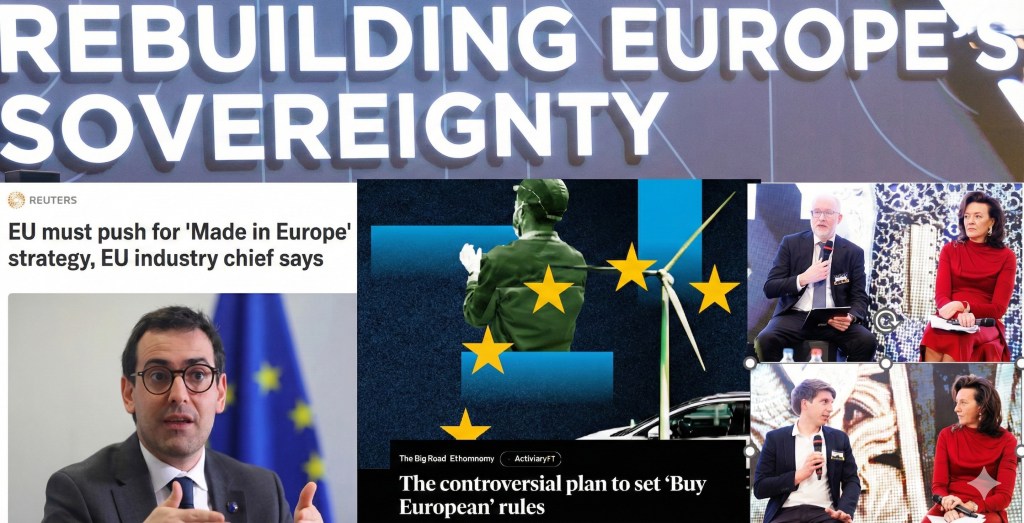
Are we finally seeing a pivot towards “build” instead of just “regulate”? Maybe finally so. After a year of banging the drum for “Eurostack”, we have become an established policy initiative with resonance in Brussels and national capitals. This is a major result: while regulators and institutions still perfunctorily appear to fly the flag for regulation, there is a lot of emphasis right now on the notion we should pursue “digital sovereignty” (or variants – it does not matter what you call it – see beginning of this piece for references).
What does it mean? Essentially, build. Don’t just demand regulated access to US digital infrastructure, which means more years of uneven legal fights – or worse, just buy from US suppliers. Build our own. The emphasis on “build” is essential. We do not need more discussion, workshops, calls to arms majoring on “our democracy” and “our values”. These are not unimportant, but they are still just talk. We are not going to build assets sitting around talking. We are not going to build assets also handing out bags of money (as a famous footballer once said, “I never saw a bag of money score a goal”).
There is a digital industry in Europe, with varied presence across the “stack” – there are datacentre builders, cloud companies, lots of software and a strong open source culture; there are even fabricators of chip components and complements, and of course global lithography champion ASML. European suppliers are not demanding just subsidies (the usual expectation of the bureaucracy). They primarily need more demand going their way, which generates the incentive to create bundles and integrate into the products customers want. The public sector must be steered into “buying European” at least for part of their needs: governments must sit down with industry and pre-commit to procure products (organizations like German Federal agency Sprin-D also champion this concept). But it’s not all about the public sector: we see that in the new geopolitical environment where dependencies are stark, and resilience has become a priority, the private sector is beginning to move too. Some seem content to remain a mouthpiece for hyperscalers, but others are actively demanding European alternatives. And the industry is organizing – various businesses are moving together to build the EuroStack. Stay tuned, but this needs to be an industrial policy project with European industry at the helm, working together with governments. As we said many times, not a top down “hundred millions for meetings” (usual approach), but an industrial roadmap. “Digital” must be treated as a strategic sector the same and more than defence, energy, green tech – as it is pervasive across the economy and differences in digital adoption are at the very core of the slower productivity growth in Europe over the last 20 years relative to the US (as clearly shown in the Draghi Report).
Is it easy? No, and there is a lot of pushback from hyperscalers and their proxies with the usual “strawmen” technique. But Europe has no alternative – it is absolutely time to get that economic digital regulation (while a principled and deserving effort, if you can make it work) is not the tool which can power up European supply and put us on the way to greater resilience and self-reliance.
(Disclosure: I have nothing to disclose as I receive no payment from anyone on issues relevant to this discussion. The EuroStack industry Initiative is a grassroot volunteer group where no one receives payment from anyone).



 The “Post-Bubble” Blog