

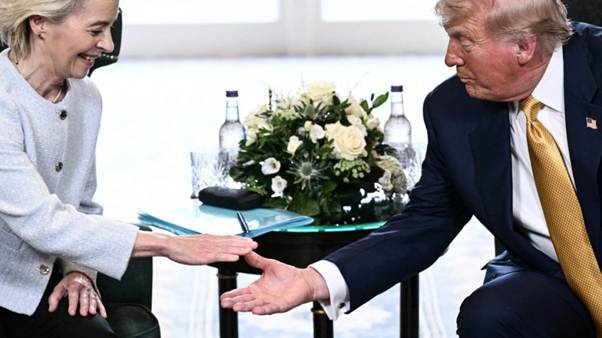
Here we are: very nearly a year after the Draghi Report thudded into Europe’s inboxes, both as a wake-up call and a roadmap, and Europe has sunk deeper into self-loathing, impotence and a typical continental wallow. The ridiculous Turnberry thumbs-up photo of the European Commission trade team looking glum next to the American wolf-grinning ‘submission squad’ made the rounds with general commiseration for our further descent into vassalage, servitude, dependence and general defeat. While what was “agreed” remains entirely unclear (and maybe will turn out to include a blancmange of vacuous fake “investment fund” promises), the commentariat has not minced words on the perceived failure of our political elite to show leadership. It is still possible they might be all Machiavellian geniuses and their brilliance may eventually be revealed, but no one is setting much store by that interpretation. The most positive thing anyone has been able to say is “it’s a good outcome because it could have been much, much worse (look at the Swiss!)”. If that’s our measure of success, even a train wreck stabilises a moving train.
None of it is a surprise. The Biden administration was officially benign and privately disparaging of Europe being so ineffectual. But Trump and MAGA are not benign. They are picking at Europe’s weaknesses one by one, flexing the trade muscle as a geopolitical extractive tool and a “correction mechanism” for perceived fundamental differences in culture, values and approaches. In discussions with Republicans in DC these days, Europe’s abandonment of “Western civilisation” and surrender to immigration, feebleness in defence, embrace of social wokeness and deliberate misunderstanding of the American notion of “freedom of speech” – all loom large in every discussion. Through this lens, “tariffs” are not remotely just about “trade” or even a tool deployed to implement industrial policy (they would be the wrong tool anyway), but a blunt instrument to realign allies and foes, and in the case of Europe beat at our ineffectiveness and lack of effort, pushing back against our regulation overdrive. But Europe’s inability to muster any retaliation strategy, and even indeed oppose resistance to the narrative that we are needy and enfeebled, is not a product of recent events – it is the result of three decades of neoliberal disjointed backsliding across all policy areas. 1995 is not coming back, y’all. My “Perfect Storm” Conference last January captured a moment, but storms have continued to batter Europe ever since.
A few motivated propositions from me below. Upshot at the end.
The “could have been worse” camp is doing everyone a disservice.
There is a theme emerging by a few – purporting to be the calm cool wise heads amidst the outrage – along the lines of “the tariff deal is bad but well done EC team, it could have been much worse!”[1]. Yes Brazil and SWITZERLAND have done much worse, as have a handful of other places, but hey we did get the same as Japan! What is true is that relative tariffs count most, and yes we have not done worse than Japan and Korea and the UK. But did Europe’s failure to retaliate and deploy any countermeasure lead us to a better place? The framing of “we started at 30%! we ended at 15%! yay well done us!!” is not comforting. There was an opportunity for Europe to escalate the trade war in April alongside China’s retaliation, and is hard not to see Turnberry as a capitulation. The Commission team ultimately did what the European capitals told them to do, and the feeble performative protests emanating from these capitals confirms this was the agreed position. Similarly, Europe failed to come up with a concerted retaliation strategy with Japan, Korea and the UK to get the US to dial down. But to defend the “could have been worse” line is useless for Europe. Cui prodest? Seems even the analysts in the end just want nothing much to change. Just reassuring the elite let’s stay cosy we are not coming for you.
Tariffs are not just about reshaping trade flows – whatever the plan and outcome at home, they are about much broader coercion of counterparties abroad.
We are all familiar with the official justification: the MAGA diagnosis that the US has been carrying large trade deficits with multiple counterparts, it’s time to put an end to that, redirect manufacturing investments into the US and use tariff revenues to lower taxes at home. We are also familiar with the scepticism and the warnings that this would not deliver reindustrialisation, would lead to inflation at home in the US, redirect trade and contract output both in the US and for trade partners. All that is the stuff of endless analyses by macroeconomists, where the question is how long can the US economy defy gravity before we see signs of distress – are we on “the precipice of recession”, or are we just going to see gradual passthrough of cost increases into prices, accounting for perhaps 1-2 CPI points?[2]
But as everyone should know by now, the European surplus is massively distorted by pharma trade from Ireland,[3] and the real source of global surplus is China – with its massive overproduction, inability of the domestic market to absorb it, and export-oriented economy. Yet Europe got hit. And China keeps trucking, playing the long game while increasing production, sales, and exports – all setting new record highs in July. [4]
This is just not a “conventional trade war”. Trump is wielding tariffs as blunt tools to address all sorts of broader issues and extract all sorts of unrelated concessions from counterparts – even though the purpose is often unclear and internally contradictory.[5] In the case of Europe, it is about making sure we understand who is boss, that as an export-dependent economy access to the US market should not be taken for granted, that we have no real credible plans for an industrial policy of our own, that we need to spend more on defence and spend it in the US, that our energy policy is all over the place and we better buy American fossil fuels. And it is about cultural values – from wokeness to DEI to “irresponsible immigration policies” which are “undermining the values of Western Civilization”, to suffocating tech innovation with regulation. Do we have to succumb to this view of the world? No, but we did. And it seems to be working.
Europe’s trade thinking is stuck in 1995.
Europe’s trade policy, outsourced to Brussels, has remained resolutely neoliberal for decades. DG Trade has been a bastion of proud orthodoxy forever, a total faithful to the Washington Consensus on open trade and to the vision that comparative advantages will drive trade flows; mainly focused on the US without really grasping the threat that China poses. For Europeans, WTO rules adherence has become an end, not the means to an end. Biden trade officials regarded Brussels as an impossibly rigid stalwart of trade conventions, refusing to entertain how trade could be differently imagined to be consistent with other areas of policy. Trade orthodoxy in the US was challenged over the last few years by “antimonopoly” coming into view, and the realisation that free trade often operated to monopolists’ advantage – for example, digital trade liberalisation was exposed as a Big Tech tool to ship our data across borders and entrench their market power. And there was a discussion of how trade policy could be designed to lift the Global South at the same time.[6]
In Europe no connection was drawn between trade and monopoly power. The antitrust link was simply alien. Different domains entirely. We do trade over here, we have our special rules. Nothing much new since 1995: WTO orthodoxy (safe when it did not suit Europe in a particular sector, never mind), and the religious belief in “free über alles”. Negotiating with Trump in 2025 still thinking it’s 1995 cannot promise results. And it didn’t work.
Our industrial policy is held hostage in European capitals.
The lament that the keys to industrial policy are jealously kept in national capitals, and the EC has limited powers and spending heft, is an old one and certainly one of our major flaws as a Continent (both Letta and Draghi go on at length about this). Will not repeat here, but there are very good analyses of the cost of fragmentation (see for one James John, IMF, dropping at my conference the extraordinary analysis that barrier to internal trade within Europe are equivalent to a 40% tariff in goods, and over 100% in services – and oft-repeated statistic since); and free-riding concerns based around mistrust. So we are uncoordinated, disjointed and unprepared, stuck in a “mid-tech trap” (cars, pharma and machinery), with a random disastrous state aid policy and pining for a digital resurgence which is not in reach. [7]
There are again very good analyses out there from Sander Tordoir and others about what Europe should do, and what Germany as our lead industrial power should do.[8] There are whole manufacturing sectors Europe still excels at (airplanes, green tech), our entire manufacturing sector is bigger than the US, and employs a multiple of workers – yet we are perilously poised “between the Chinese hammer and the American anvil” (S. Tordoir). Again, the problem here is not just the US. China is unleashing a Second Shock, and not just in cars and EVs, but also robotics and, on the horizon, airplanes. Across a wide variety of sectors, China’s successful industrial policies, coupled with weak internal demand, are resulting in a massive export push, but this time in core markets for hitherto leading EU supply chains.
The simple truth is: Europe is fighting a two-front trade war [9]. Yet ask bureaucrats across European capitals about the Second China Shock and they look at you uncomprehendingly. As recently mentioned, “Europe outsourced its entire industrial policy for years to China and the US”[10], now are we surprised we don’t have one. It’s fragmented and scattered, yes. But who would set the roadmap even if it was centralised? The Brussels bureaucracy? The overwhelming consensus is we need a Single Market, as internal demand is our best weapon. But other than Germany’s fiscal revolution, which is adding demand, we are making no progress building the European market around it – let alone using trade and industrial policy to avoid our demand being captured by non-market Chinese competitors.
Our energy policy is in chaos.
Rely on nuclear, phase out nuclear in favour of Russian gas, bring in renewables, now buy LNG from the US. But in the end, what does industry need and want? Crickets.
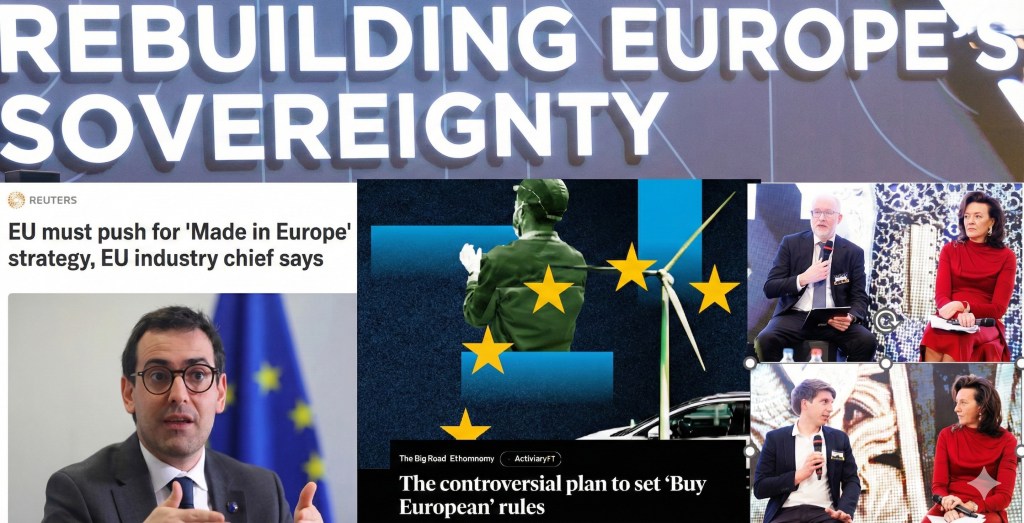
Relying only on digital economic regulation has been a distraction for Europe. We had no plan to create a European digital infrastructure. Sovereignty calls are coming very late.
The most vocal constituency of “European patriots” (they’ll hate the word) in recent months has been the antimonopoly movement – think tanks and civil society – lecturing the Commission on how they must not “sacrifice” our digital regulations in a crude barter for lower tariffs with Trump. Add to this the cohort of academics who need something to write about, and the club of practitioners (lawyers and economists) who make money suing tech companies and for whom rules like the DMA are useful to continue to advise complainants and bring damages cases.
The argument is always a variant of: “Europe cannot sacrifice its rule of law for tariff gains!”[11]. Sigh. That European digital regulation has become a poster child for “non-tariff barriers” or even “non-tariff attacks on successful American companies”[12] is of course bad. That regulation has been massively resisted, circumvented, prevaricated by its subjects is also bad. This is not just “ordinary” monopolist malevolence though. There is also a genuine dose of “it is intolerable for a bureaucracy of lawyers to be interfering with how we design our products” and also “what do you Europeans think you are achieving with this? How does “taming us” help you get your own digital industry?” And THIS is for me the crux of the matter.
We have plunged headlong into economic digital regulation (I am talking mainly DMA) as if this was by definition, self-evidently THE ANSWER to Europe’s gradual surrender to American tech giants. I always struggled to understand how a bunch of antitrust-inspired behavioural rules, copy-pasted from a bunch of failed antitrust cases, with the experience that remedies were impossible to enforce anyway in those cases) were going to (a) be enforceable in anything less than YEARS, and (b) were going to really DO ANYTHING other than for the few direct competitors who brought the complaints. Maybe. All jolly existential for Epic, Matches, Spotify, Kelkoo, DuckDuckGo, and a few more app developers – but what is the problem we are trying to solve? This was only ever about competition for apps and services ON the platforms. Not FOR the platforms. Yes, interoperability, yes tell me the story of how challengers can grow and create alternative platforms etc. Maybe, with years of effort. But in reality the kind of weak behavioural rules you get out of antitrust and economic regulation are (almost) never the way to get to creating a true asset-based competing infrastructure. Which is what matters for Europe.
So tell me again: what does the DMA do to create a European digital infrastructure?[13] None of the DMA fans can answer the simple question: tell me what these rules can TRULY do for Europe, in terms of powering up our own digital infrastructure. Weeell, maybe if we got somewhere on interoperability, and a few companies could get to grow a little, then they would consider building their own cloud? (Real life example: Proton). But this is quite far-fetched and far out. Europe IS a digital colony and there is nothing the DMA as conceived and enforced (de facto an antitrust tool) could truly do about it. Even if it were enforced, quod non.
So, antimonopoly friends: you are SUPER late to understand that Europe’s REAL problem is not how the Search page looks on Google and whether it is fair to Booking.com; nor whether there is another app store in my iPhone. It is the fact we have a shrinking cloud industry, a software sector which is going nowhere and is desperately under-resourced, and we are not even in the game in AI.
I get the distaste for US digital monopolists (much of which is cultural/political) but the single-minded obsession with “our” DMA (DSA is somewhat different) sucked up all the energy and the bandwidth from something else that should have been a priority: build. Imagine: “Mr President, 90% of American infrastructure is owned by Europeans! Oh I know, let’s pass a DMA” – would say absolutely no one ever in the US.
Hence I do not think the defence of our digital rules is remotely existential for Europe. DMA or higher tariffs on cars? It’s not even close – we absolutely must prioritise cars. Because that’s the reality. And by the way, these rules ARE part of the trade deal – it just wasn’t made public because the Commission had enough bad news on its hands to include this in the communication. But, really, the fight for Europe’s resilience and indeed a modicum of sovereignty is elsewhere (see below on EuroStack). We have another set of much bigger problems in Europe. The economic crushing of the Continent.
In the same spirit: I also get that for American progressives at this point Europe feels like the last “ray of hope” and we get a lot of push that we should be brave and hold up “our rules” – thanks, but just because you have not been able to get anywhere with digital regulation yourselves does not mean that it is up to Americans to lecture us on what is good for us. You do not understand that Europe has much more existential problems than “taming Big Tech”.
Our tech and innovation policy carries enormous outdated baggage.
Draghi said Europe missed out on the first internet revolution, and it should not miss out on the second. Amen. But who should have designed the vision? DG Connect in Brussels is a sprawling bureaucracy with no commercial experience. Virtually no one there has started or run a business. There is a bias for academic research and very limited focus on promoting commercial-grade products. There are grandiose-sounding top-down plans (Horizon Europe, Digital Decade, Next-Generation Internet) all spraying money around in multiple initiatives with baroque application processes. There are the hundreds of millions for meetings and sightseeing (Linkedin photo “great meeting of our X group in Bratislava/Lake Como/Barcelona!”)
Can this set up credibly design the future of the European tech industry? From a desk in Brussels? No wonder we see peculiar ideas like gygafactories coming to the fore. And then we have the usual litany of national realities: too small, too local, bureaucracies are incompetent etc. No wonder US tech companies have rolled out and carpeted Europe with infrastructure and services, in this total vacuum.
The EuroStack Industry Initiative[14] is an effort to push the European tech industry to self-organize (no centralised, top down “millions for meetings”) to deliver what the European institutions generally haven’t: industrial capacity along the “stack”. Not just access to Big Tech castles for our apps and services, but infrastructure from cloud to software to connectivity. Emphasis on “industrial” – Europe does not need think-tank talk-shops but industrial muscle to reverse at least in part its near-complete dependency on US tech, and in the process create more resilience and optionality. European businesses are hugely concerned about dependency and there is a major drive to shift demand (public and private) into European options. We are talking about sovereignty finally, and it has a lot of traction – but how late is that?
Antitrust is not the main engine for growth but this does not excuse rigid thinking.
The European Antitrust Bubble recently saluted the retirement of the Director General of Competition Olivier Guersent with the obligatory dose of sycophancy and “missing you already”. The exit interviews were the usual soft-ball fest, allowing all the defensive bluster to go unchallenged (“don’t scratch our enforcement Rolls Royce”) and bounced around the Bubble with hagiographic tones and total suspension of critical faculties. Of course, I don’t begrudge tribute paid to a career civil servant who was upstanding and had personal integrity. But Olivier Guersent should be also remembered for the infamous comment at my 2024 conference that competition was “just a side dish” relative to other important economic policy tools such as trade and industrial policy. This extraordinary statement about one of the most powerful tools in economic policy – the power to decide on the allocation of assets – did the rounds for a while and was justified ex post with the homily that “competition enforcement (or merger control, you name it) cannot be deemed responsible for generating economic growth”. Well yes. No one said that.
However, competition policy should play a conscious and salient role in the pursuit of a fair and prosperous economy. We have had decades of disastrous State Aid enforcement – a total mess with no rhyme nor reason when it came to vetting Member State subsidies. More broadly, the European Competition Bubble has ossified within the principles and methods developed out of neoclassical neoliberal dogma and because it is a cottage industry of lawyers-consultants-officials-academics all on the revolving door threadmill, it is closed and impervious to intellectual debate. Rather than welcoming debate, there is collusion between stakeholders in the profession not to “rock the boat”. Mario Draghi asked: “what can competition enforcement contribute to the European predicament?” – this would have deserved a serious thoughtful answer, bringing together a serious working group of macro and finance and trade economists. But no, the profession is run by the IO hegemony (and the Big Law complex) who absolutely defend their patch and have nothing new to say (a recent public debate on the revision of the Merger Control Guidelines was highly cautious and boring).
For instance, we seem to be reducing the serious question posed by Mario Draghi on whether the telecom industry should be allowed to consolidate to an incredibly dumb debate where the industry says “hell yeah, we are not making enough money to justify investment” and the Chief Economist team responds with an analysis purporting to show that telcos’ ROCE is actually higher than their WACC. And therefore (as Olivier Guersent actually said in his exit interview) the telcos’ claims are “gigantic bulls..t”. Wow, is this it? Is the discussion on the relationship between competition enforcement and investment/growth going to turn on the old telco debate? The Consultation on the Revised Merger Guidelines at least poses the question, is there going to be serious thinking on this? I hope it will not be a version of “but it’s not our job right? we don’t have to think about growth? we can continue toying with bargaining models over here. someone else’s job”.
(US enforcement meanwhile of course has its problems. For sure populism is unravelling on the right but also on the left. But this is for another day and not the focus of this piece).
The upshot.
Europe is caught in a polarizing China/US world, with Russia’s security threat looming on the Eastern border, finding it difficult to move on from an export economy model for goods that China is now better at making, and America is closing the door to; with no defence policy and no digital industry and no industrial strategy to speak of. We are not fully grasping the threat China is posing yet. President Trump is exposing what Mario Draghi said a year ago (“we are hitting existential crisis”) and Mario Monti said 15 year prior (‘we will hit existential crisis”). We had a vacuum of initiative in a fragmented reality for decades, and it’s not surprising we are now like deers in the headlights. There are ideas around (really pay attention to EuroStack) but “Armons-nous, et partez!” remains such a true epigram of all that’s wrong with Europe. The window is really closing.

[1] See Aslak Berg, In defence of a bad deal | Centre for European Reform 7 August 2025. Jean-Luc Demarty (former Director General of DG Trade) makes the point with a few more qualifications in The trade deal between Donald Trump and Ursula von der Leyen, while being the least bad one, is a geopolitical disaster for the EU | Comment | Encompass, August 2025.pharma
[2] See Oren Cass, Why Won’t the Economy Listen to the Models? – by Oren Cass 9 August 2025, and What Color Are the Lights on the Economy’s Dashboard?, 11 August 2025.
[3] See Beth Baltzan, The Pharma Canard — American Phoenix Trade, 25 July 2025. See also American Affairs, Relearning Adam Smith’s Lessons on Trade, forthcoming August 2025.
[4] See anything by Brad Setser, and Sander Tordoir, including: Sander Tordoir on X: “The biggest story in the global economy. It isn’t Trump’s tariffs — not even close. But for the rest of the world, especially Europe, surging Chinese exports and US tariffs are conspiring. Too many sellers, not enough buyers.” / X, 7 August 2025
[5] Michael Pettis on X: “1/7 NYT: “President Trump’s tariff threats have turned into a play for cold, hard cash as he tries to leverage U.S. economic power to cajole other nations to make multibillion-dollar investments in order to maintain access to America’s market.” https://t.co/jF2vFPKHNl” / X
[6] See Competition Policy RPN – Shifting the Trade Paradigm | CEPR, with Trade Ambassador Katherine Tai and Simon Johnson MIT, 24 July 2024.
[7] Anything from the Jacques Delors Centre, from Delivering on Draghi – The EU’s clean industrial strategy | Jacques Delors Centre 20 February 2025, to most recently Ripe for Reform – What’s in the EU Budget Proposal and Wh | Jacques Delors Centre 1 August 2025.
[8] Anything from Sander Tordoir e.g. most recently For European Economic Policy, the New World Has Yet to Be Born – Intereconomics June/July 2025, Heavy Industry Is Europe’s Military Trump Card Against America Foreign Policy 7 March 2027, How to build and fund a better EU green industrial policy | Centre for European Reform 19 February 2025,
[9] Brad Setser, China is also fighting a trade war with the EU (and winning), Council on Foreign Relations, 28 July 2025.
[10] Matthias Matthijs, U.S.-EU Trade Deal Avoids a Tariff War, but Deepens European Dependence | Council on Foreign Relations, 30 July 2025. Also Sander Tordoir in Intereconomics: “For three decades, the EU externally anchored its trade and industrial policy”.
[11] For one example see Robin Berjon and Cori Crider, Digital sovereignty can’t be bargained away – POLITICO 3 July 2025 and many more along similar lines.
[12] For one of many see Alden Abbott, Why The U.S. May Confront Non-Tariff Attacks Against Tech Firms, Forbes 2 July 2025.
[13] And I have not said this in the last 5 minutes. See Cristina Caffarra, What are we regulating for? | CEPR, 3 September 2021.



 The “Post-Bubble” Blog