

It is oh-so-European that just when the imperative of getting more European assets to support our digital life is finally established (was staring at everyone in the face for some time, yes?), multiple corners of our public sphere still wring hands and knit eyebrows and muse “but what does digital sovereignty mean? what is the purpose? I am confused!”. Here’s the answer to this definitional agony: it’s an industrial project aiming to emancipate Europe (at least somewhat) from its total digital dependency, from being a vassal continent, by building and scaling European digital assets and capabilities. All in a context where it is clear that the European economic model is unsustainable and needs urgent overhauling (Draghi) and we entered an extreme era of wars, acute defence needs and geopolitical upheaval. That’s it. These are the objectives: support European business, create resilience and put things we care about (like our data) under our control. How can anyone be “confused” about that.
And there’s only one possible direction of travel: build. Everything else is a distraction. Honestly, friends, this is not primarily about “defending our democracy” though sure, being less dependent helps. It’s not primarily about “our European values” though sure, privacy and freedom of speech are natural parts of our way of thinking. But I lose patience with this discourse (typically from civil society and think tanks) because what we need is single-minded focus on building, not piety and moralizing around this stuff.
The EuroStack movement (Euro Stack | Building Europe’s digital future), officially born at a conference I co-organized in the European Parliament at the end of September 2024(1), has been described to me by old Brussels hands as “the most successful policy movement we have seen here in the last 10 years” – gone from nowhere to everywhere (press articles in every country in Europe, events, roundtables, mention in government programmes) in 9 months. It spread like wildfire and made tremendous progress – with the Draghi report and regime change in the US acting as major catalysts. A major propeller has been the call to arms to a European digital ecosystem disillusioned that our super-hyped digital regulation just cannot deliver a “level playing field” and transform the fortunes of European industry in the face of relentless progress by hyperscalers: our regulators simply cannot do anything to “tame” anyone, and in addition regulation alone does not “build” our own assets.
Can we now please focus on what we concretely need as a matter of extreme urgency? Musing around “what is the definition of digital sovereignty, what is the goal” is just annoying because it is pointless. Philosophize away. Write us an essay. The rest need to build and scale up and get adoption – now. The only relevant goal is building (and again, scale up and accelerate adoption). And to do that we need to urgently map out what’s needed for it as an industrial project. How on earth is anyone going to build anything without industry doing it?
Build what?
Build what? Leaving aside chips and quantum (which do require big-ass investments), the most immediate goal has to be to build European cloud alternatives and create bundles of software on top, that offer attractive functionalities. This is urgent, as it is foundational for the AI effort as well. That’s it. Of course it’s not simple. Of course it’s a complex task. “Cloud” is not a single thing, the term covers a complex set of components from datacentres to servers to storage to databases to connectivity to all forms of software on top (the “cloud ladder”) – and there are European suppliers/lookalikes for some, much less for others. Some are commodity, some are much less advanced or not there at all, and there are certainly gaps relative to the all-inclusive, turnkey, ready-to-play offerings of the US hyperscalers (read the splendid Bert Hubert opus for a technical lesson: A coherent European/non-US cloud strategy: building railroads for the cloud economy – Bert Hubert’s writings for instance).
Why hasn’t European industry done it so far? Not because of lack of skills and tech on the supply side – mostly because of shrinking demand, as hyperscalers have relentlessly advanced (building on their first-mover advantage with sweet introductory deals, and then locking the European demand-side in – something our antitrust regulators are just unable to undo). Without demand, the supply side gets asphyxiated – investments are not worthwhile, they don’t pay off. Incentives to create products depend on the prospect of selling them. Public institutions capitulated en masse to US hyperscalers, and European industry (cars, retail, financial sector) fell into the same groove: convenience, lack of competences in house, what’s wrong with outsourcing everything? And then of course there is funding – which for “gappy” products is key and where our capital and banking markets have miserably failed, leaving the European Commission to pick up the pieces (without success given again lack of commercial experience and the bias in favour of research, leading to routinely funding conferences and meetings instead of commercial-grade products).
What is needed now are three things (as EuroStack keeps saying – see our more recent roadmap, The White Paper – EuroStack):
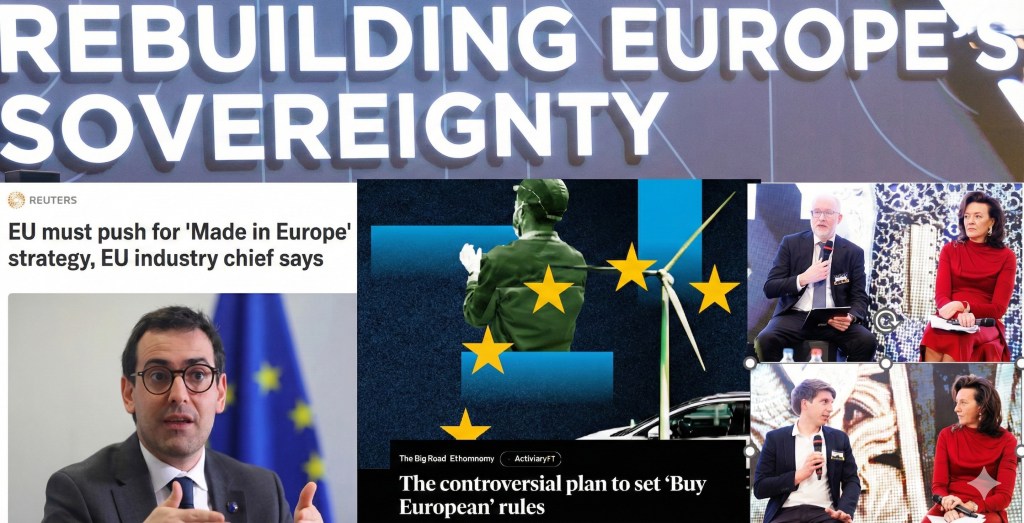
“Buy European” – changes to the Procurement Directive to create mandates for public sector buyers to buy from European suppliers for at least a portion of their demand. Things will not happen spontaneously in the public sector in particular.
– No, not all of it – we are saying a portion. Public sector IT demand is estimated at €70bn a year, a portion of that (30%?) would be a major shot in the arm to European industry
– No, this will not be in breach of WTO rules (and the US would not sue us, as confirmed by US Trade experts.(2) This is a complete red herring).
– No, this will not reduce competition but increase it.(3)
– The private sector cannot be given mandates but we know industrial groups, financial institutions, telcos, retail groups and many other major customers are worried about dependencies – better late than never, give them incentives and breaks, especially to address very significant lock-ins and migration costs.
“Sell European” – industry needs to get its act together and create products people want to buy – by leveraging Openness (Open Source) which is Europe’s special sauce, by creating collaboration and common standards. by investing (if there are guarantees of demand, again: “we will build it for you if you underwrite the investment with a contract”), by merging and consolidating. (GaiaX failed because the Commission giving in to the hyperscalers’ “inclusion” pleas poisoned the well – no reason everything should in the same way. We have multiple pieces of relevant software, how do we integrate them in a support platform? How do we offer bundled functionalities? There is enormous appetite to do this in the industry right now. We need to harness this energy, and not disperse it into paperwork.
“Fund European” – this is a grave European flaw, possibly the worst of our “barriers”: our banking system just does not fund anything other than boring real estate-type businesses. American friends continue to shake their head at the weakness of our funding structures. And yes, public funds can be useful to fill gaps but in a targeted way.
Build how?
What do we need most urgently?
1. Commission and Member State support for “Buy European” mandates – we cannot afford to have the Revised Procurement Directive (hopefully favourable to “Buy European” rules) fall at the last hurdle because a handful of small countries who see the US as their historic partner vote against it. The Nordics, Eastern Europe, the Baltics, Italy. This is not an anti-American stance, it is not a protectionist stance, it will not reduce competition but increase it. As said many times, we would limit “Buy European” to a portion of demand (we could not ask for more as it would not make sense anyway). And we know that procurement isn’t the only answer. But as the rest of the world does not blink at “Buy American”, it is unfathomable that we could not do at least some of that for ourselves. Not a complete solution, but part of a set of tools going in the same direction.
2. National governments can move things along spontaneously by making their own decisions, without waiting for EC procurement mandates: see the positions taken by the state of Schleswig-Holstein in Germany, and now Denmark declaring they would no longer buy Microsoft services. Others are also on the move, from the Netherlands to (wild) Sweden. Bodies like ZenDis in Germany commissioned private sector players to build collaboration software OpenDesk, which in principle is a good idea (certainly a better idea than the public sector trying to develop and sell software in competition with private suppliers, like DINUM in France). There are other isolated good ideas, like SprinD and Sovereign Tech Agency in Germany.
BUT to move the dial really requires a change of mindset: it is NOT useful for the bureaucracy to continue to think of itself as just creating disbursement mechanisms (EDICs, IPCEIs) which spray money around to multiple consortia on a bewildering array of activities – from hackathons (!) to workshops to meetings and more meetings and more white papers. If governments and public institutions are to help building (inertia is also a choice, but not a useful one), they need to bring out blinking into the light their hidden tech people in basements (I met some! they exist!), and hire serious competent deep tech capabilities to engage with industry.
3. Industry side: work together to identify gaps in offering, merge and connect through collaboration – Industry has a major gap to fill. The supply side needs to organize itself to offer integrated bundles, consolidate and develop common standards. And because it is difficult for things to happen entirely spontaneously, well-motivated narrowly targeted public funding for discrete initiatives would be of course useful – as long as it is done in collaboration with industry, e.g. to fund the expansion and filling of gaps. We DO need an Airbus model. In the US industry works together with the government the whole time. We are instead in the curious position that our bureaucracy is suspicious of industry and goes off on a tangent of its own (see AI factories: whose idea?). Think tanks pontificate and don’t want to upset institutions on whose funding they rely. Civil society has a deep mistrust of industry because it converted late to “antimonopoly” in Europe and finds it super hard to think that a profit motive can be benign (as opposed to oh, “values”).
What we don’t need
We don’t need procrastination, mystery and condescension from our European institutions – who feel threatened by people speaking up and whose world revolves in arcane ways that mere mortals are not allowed to understand. The response to EuroStack (a growing grassroot industry movement) by the Commission in Brussels has been either to ignore it, or to proclaim “oh we are already doing all that, it’s called Open Stack” – but this is obfuscation, as Open Stack is nothing of the sort (it is a small €10m programme on something else).
We also don’t need another huge lump of money allocated to some grand-sounding programme in some unspecified future (another “Horizon Europe” or some such). We are now all being told “there’s no more money left in the current budget, nothing till 2028, you focus your big demands on the next MFF!” – but this is a distraction, “pass the parcel” to sometime after 2028. We cannot afford to do that and also think it all begins and ends at a lump of billions to be showered “helicopter style” on Europe sometime after 2028. The future of the European tech industry cannot be decided at a desk in Brussels, with capricious funding allocated by career bureaucrats (or worse, academics) to bodies that then become dependent and captured. Get closer to the tech, involve industry.
We don’t need think tanks without experience of business who never studied an investment deck creating a dust storm with “we need to set up a big public fund! Hundreds of billions! to fund everything from Brussels!”. You can’t create a big fund and then say “now give us a cloud”. The reality is there is clear aspiration for advisory roles and funding for any number of white papers mixed in with these proposals (EDICs are bureaucratic nightmares, IPCEIs involve hundreds of millions for meetings and research). We also don’t need civil society studiously avoiding the plain truth: that “building” anything means industry, and must mean profit – oh no that horrible word! How do we ensure purity of intent when companies expect to make profits? We don’t need fretting about whether we are attempting to “replicate US hyperscalers, only Europeans”: in reality we can’t, even if we tried – European players are small and fragmented and will not get any market power for a long time. It’s more a question of surviving than wielding power.
We need to think about this first and foremost as an industrial project. With some public support but one where “industry” (the supply side) needs to be given the incentive to build, and the opportunity to scale and expand. We don’t need more “events” and pensive stuff about “our European values” and “democracy” around digital sovereignty. Industry should do its thing, or nothing will happen. Wake up.
(This should not need to be said as I said it many times before, but here goes again: I am not an industry lobbyist, or a lobbyist of any kind. I am not paid a cent by anyone to say or do anything in relation to EuroStack or any of the contents of this post. Pure passion and personal conviction).
- The original organizing group included also Francesca Bria, Alexandra Geese, Kai Zenner and Meredith Whittaker. Everyone else out there claiming to be a “founder” is making things up.
- Buy European, Buy Democracy — American Phoenix Trade, 24 March 2025. See also Designing “Buy European” Policies for Strategic Autonomy | CEPR, 15 April 2025.
- For recognition that a Buy European rule would not be opposed by antitrust agencies, see EVP Ribera (albeit in a different context, green tech): Inject equity in green industry not subsidies, EU tells capitals, 25 June 2025.



 The “Post-Bubble” Blog