

The Economist magazine’s Charlemagne column this week is a breezy piece in vintage Economist style: jump around, connect a few factoids, put forward a seemingly “contro” (and of course neoliberal) point of view, sign off. This time it’s about the apparent “trope” that “Europe Fantasises About an Airbus of Everything!” – that “no industry confab” in Europe is complete without a call for creating an “Airbus of something” (chips, green tech, satellites, cloud etc) – but really we need to resist all of this nostalgia for state support which is oh-so-1970s-glitterball, and most importantly is being pushed by corrupt politicians who want to cut ribbons and greedy entrepreneurs who want to make profits at the expense of consumers.[1]
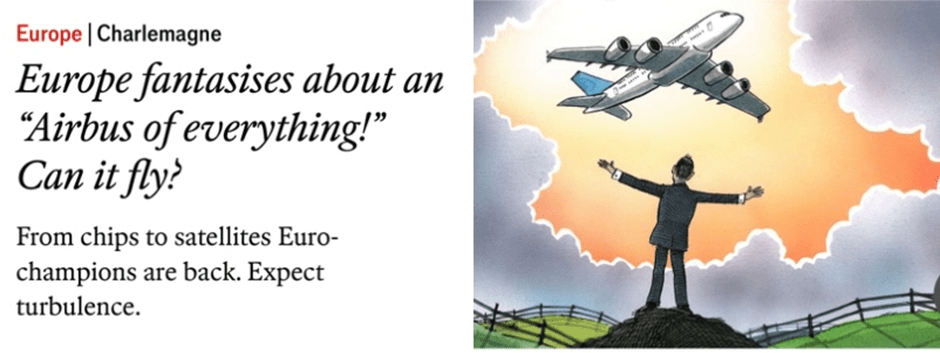
While of course we need to learn from past mistakes, and there’s lots of corrupt politicians and greedy businessmen out there who would like “less competitive markets thank you”, this is a tiresome tired homily at this moment in our history. The question we are all faced with, urgently, is encapsulated in what I call the “Draghi mission” – Europe has finally arrived (10 years after Monti warned about it) at the point of existential crisis of our entire economic and social model. Add that we are at war (has anyone noticed?). Add to that, President Trump is pushing to overturn the global trade order with consequences we cannot fathom. The Economists’ piece reads like a classic from the 2000s. Or again from the 2010s. Basically Airbus was great, it worked great, but…. you don’t want to indulge the hope it could work again today. Don’t “fantasise”, Europeans. Don’t dream you could get it together by pooling your scattered assets in some way, because you know, it will end in tears – with consumers “paying for it – but long after today’s batch of politicians have disembarked”. So what should Europe do, prey tell? Crickets from Charlemagne.
At an event in Vienna last week[2] Mario Draghi lamented we are still doing little to address our structural challenges (which frankly we have known about for 10 years) and holding back the growth of scaleups. Draghi was very clear in his September milestone report about the importance of scale. As I said many times, this is not a universal prescription for relaxing merger control (how boring, that fake discussion) but it is incontrovertible that a key reason for the widening gap in our productivity growth with the US is that our micro-sized firms do not adopt and diffuse technological change at the rate that is required to keep up. Draghi repeats this at every turn. Enrico Letta, who also wrote a seminal report for the EC last April, said as well in an interview a few days ago[3] that yes, we are facing our known ailments and structural impediments but for crying out loud, “we have to organise ourselves to be competitive. We are a small continent. The EU is divided into two groups: small countries, and countries that don’t know they are small. Even Germany and France are provinces of China.” “We have to move”. Amen.
In fairness, the Commission issued just last week its “Startup and Scaleup Strategy”,[4] with the ambitious goal of “making Europe a powerhouse” – let’s hope this does not ring hollow in three years like previous European initiatives which typically turned hundreds of millions into meetings. It’s a start, though the resurrection of the European digital industry from total colonization by US digital giants needs to go beyond startups and scaleups and unicorns and AI, and support also established tech, SMEs, established players that form the backbone of Europe’s tech industry, and non-deep tech sectors like cloud, software, digital services and open platforms (see EuroStack initiative, which I won’t discuss here).
But most depressing is the quality of the discourse around these realities in competition circles. I do enough conferences and events, I know the “conversation” such as it is. And just as bad, in civil society and think tanks.
The Competition Bubble Struggles to Say Anything New or Interesting
There are small, isolated signs that someone somewhere recognises that maybe something really big is happening out there (war, economic armageddon, trade upheaval), and we should maybe pay attention. But in the main, the Competition Bubble remains isolated and insulated from the bigger picture. It’s extraordinary. It’s like we have been inoculated against moving forward from our established religious beliefs and even as time goes on, we still repeat the same usual boring unimaginative stuff – truly nothing new or creative.
I have three recent examples in mind, which I will refer to without identifying the papers or the authors because they are friends and it pains me to be critical (people have super thin skins as well these days). These are papers from big names in the Bubble, and I read them shaking my head and thinking “boring, obvious, unimaginative, unwilling to move forward. No experimentation mindset”.
One is a policy paper on why competition rules should be the leading light and guiding principle for all governments designing a defence spending strategy. Good god. We are de facto at war. We have been defenestrated by the US and told we cannot rely on them anymore. We are scrambling to put together a defence capability, fast. We are a digital colony and in a world of dual use “decoupling” from US tech is necessary for our defence and yet will take time. And in all of this what we have to say is that competition principles need to be the guiding light? In what world? I read this paper and every single proposition and piece of advice is old, generic “competition speak” – I feel like putting on each sentence the sticker “motherhood and apple pie”, “motherhood”, “apple pie”. Who can disagree with these generalities and calls to apply the classic competition hit parade (“we don’t want to consolidate market power and create enduring dependencies…”, “we need to safeguard competition and innovation in defence spending…” through “dual sourcing (where possible)”, “interoperability of systems within Europe (where possible)”, “financial support mechanisms”, “innovation sandboxes” etc etc.) I mean who can disagree with this? What’s new? Let governments do what they have to do – tanks, satellites, drones, whatever is needed. Pool resources and build.
Next, a paper from a former regulator in a recent collection on “Competition and Industrial Policy” which again walks the well-trodden path that productivity growth “requires competition”, pursuing the dual goal of “protecting security of supply and promoting economic growth” again “requires competition”, that we must “use the power of competition to spur investment and innovation”, that “competition is the core ingredient”, “investment without competition resulted in deteriorating productivity and economic stagnation”, “competition delivers resilience” – yes again. So far so obvious. Not controversial. Nothing new either.
Finally, a well intentioned paper on how the UK competition mission has pivoted to growth, and in that world “competition policy can drive growth”. A step forward relative to the usual resistance of the Bubble to acknowledge anything other than “competition” as a goal in itself: it recognises that “equitable growth” needs to be a goal of competition enforcement (something I said for years – otherwise what’s the point). But the “core mission” is still all about “securing dynamic, open, competitive markets through robust competition policy”. Which is classic Competition Bubble speak. It is juxtaposed to “the alternative” which is “weaker competition and entrenched corporate market power”. But of course: who is advocating for weaker competition and more market power? Does it need to be said? No one seriously disputes that. Yet there’s a lot of the usual competition church lingo: “a dynamic and competitive business environment is a driver of innovation, productivity, and investment, all of which contribute to sustained economic prosperity” – okay okay we all agree. There is also the traditional Competition Bubble principled resistance to the idea that mergers can increase investment, the pushback to the notion that scaling up matters (only for SMEs maybe), the classic defence “regulation does not kill innovation”. The paper is a step forward as it at least recognises the need for “(c)oordination with industrial policy and trade policy, and therefore with a larger strategic economic approach” (yes, you welcome, I said this for years). But still attached to competition’s sacred cows, and not enough of a call for real experimentation.
Friends, I told some of you privately what I think. For me, there is still too much store set by the neoclassic “competition” mythology. Antitrust must come out of its elite circle, speak a different language and connect with the way ordinary people see priorities. Not from the perspective of elite IO economists and regulators. We are in deep trouble. Let’s go all in on building, and restarting the engine of growth. Competition in itself doesn’t do it. We need to stimulate investment and grow – it is simply untrue that “competition” will deliver.
“But Our European Values”
Another thing we convinced ourselves of in Europe is that we somehow carry values of freedom and democracy and quality of life that are uniquely ours and set us apart in a morally superior way from others – capitalists, fascists, techno-oligarchs. I appreciate “European values” a lot (whatever they are) and will stick up for Europe any time. But there is a moralizing about us in various quarters which is unjustified and irritating. The discourse about freedom of speech is deeply complex but we in Europe don’t have a monopoly on morality and principles. And our “values” should not be an excuse to justify our economic failures.
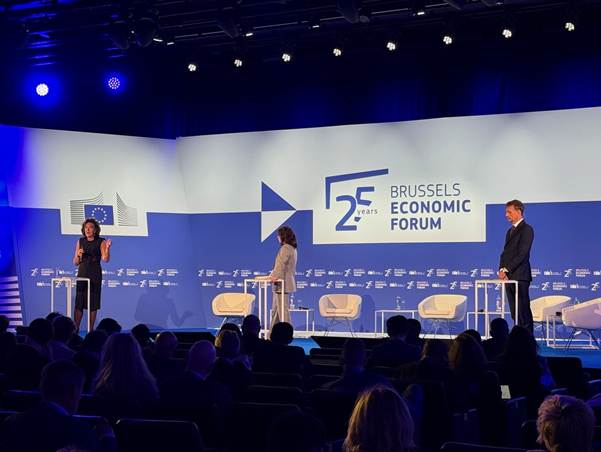
This example for all: at the recent Brussels Economic Forum, I debated in favour of the proposition that “We Need European Industrial Champions”. The opposite side, highly respected economist Jan Eeckout, used the following metaphor to argue for “European values” vs unbridled nasty capitalism: “Europe has lots of innovation, like cuddly puppies. We want those cuddly puppies not to turn into wolves who will predate on our sheep, but into border colliers”. Jan is a dear friend, but I remember thinking “Jesus, no wonder the Americans win every time”.
“Our values” – this is pervasive. To support regulation for instance. Yes, regulation is by and large a thing we want – in order to curb power excesses and establish some fairness when bargaining is so uneven. That said, we absolutely barked up the wrong tree for years thinking that regulation of tech giants alone would create a viable economic model for us. And now years later we are saying “ah it’s too late to build we will not catch up with US giants”. So double whammy: we failed to tame them in any significant way AND we did not build anything comparable by ourselves. Oh I feel better, we still have “our European values”.
Even now, when it should be plain as daylight that we need to let regulation do the little it can but we need to turn to building big time, we hear all sort of bleatings and distractions: “but we need to embed our European principles of governance into these (whatevers)!”, “we need to incorporate the principles of trusted regulation so the state can be trusted!” – etc. I don’t know what half of this means. Honestly I don’t. Young people in research institutions publish what appear to be ChatGPT-generated word salads like (I paraphrase, but this is real): “A regulatory-first approach is not a liability but a critical strategic advantage: ‘Trust-by-design’ allows to build governance frameworks that ensure technology is trustworthy by design, and in addition it restores public trust in the state’s ability to navigate challenges, crises, and transformations through effective, democratic governance”. What does any of this mean? Why don’t they ask themselves “what kind of job will I have in 20 years?”
The Great Collective Righteousness
This is our current predicament. For years we antitrusters have “known” what the righteous path was. More competition and pursuit of efficiency and consumer welfare. We gave special status to IO academics with zero business experience to enlighten us on enforcement as if knowing theory models was the path to business and policy savvy. What madness. This has been generally debunked in the last five years in the US though it persists in Europe (agencies with economists’ teams and outside consultants must of course protect the myth we know something special, for status and self preservation).
But now we are “another level”. We are in the post-Draghi world, a war economy, the Trump era. The “rightful path” that “we need to pursue competition because this delivers innovation and growth” is just no longer enough for Europe. Is this all the advice we can give to politicians and policy makers looking to turn us around? Critically, why should they care? Are we delivering growth today? Do other economic policy tools need to heed this advice? Frankly unless and until we become less pious and more creative, they are right to ignore us and do instead “whatever it takes”.
[1] https://economist.com/europe/2025/05/29/europe-fantasises-about-an-airbus-of-everything-can-it-fly
[2] Vienna BCG CEO Conference.
[3] Former PM of Italy Enrico Letta on Europe’s Future
[4] “Commission launches ambitious Strategy to make Europe a startup and scaleup powerhouse”. see 2f76a0df-b09b-47c2-949c-800c30e4c530_en, 28 May 2025



 The “Post-Bubble” Blog