

The European Commission initiated last week a consultation[1] intended to inform the first review of the EC Horizontal Merger Guidelines since 2004 (!) and of the Vertical Merger Guidelines since 2008. While Guidelines (at least in Europe) are always just that, a sense for the direction of travel rather than prescriptive roadmaps (in no case I have ever been involved in anyone gave a second thought to the EC Merger Guidelines), the consultation documents are significant as they stretch beyond the usual narrow competition purview, and ask a lot of overdue questions. A step in the right direction (and hello critics, I have been pushing at this for the last four years).
But where are the answers going to come from? The antitrust bar and the economic consultants who’ll be paid to respond will either (a) argue this is all too ambitious, no major change needed, or (b) toast Mario Draghi in boardrooms and unleash wanton consolidation efforts. Civil society will push the “antimonopoly” line five years too late. And academics will just stick to IO orthodoxy because “nothing there, nothing to see” and “we know from economics that blah” (as if it were Moses’ tablets). So where is the hope of some sensible answers? Broaden the lens: speak to macro people, to trade people, try to understand where things are going. “We are all lawyers and IO types, do we have to become macroeconomists now?” – I was asked last week at an ICN gathering. Yes, you need to broaden the discussion and experiment with policy. Test ideas. Involve a broader set of people. Try things out. Workshop ideas. Nothing should be taken for granted. Times are so serious for Europe, rip up the playbook.
The Slow Decline of European Competition Enforcement
Competition enforcement in Europe was a fashionable endeavour (and DG Competition a powerhouse) till circa 2018. Doing “antitrust” was cool and felt “important” for a couple of decades – from establishing “the more economic approach” in the Noughts, to pioneering cases against Google in the 2010s, plus a few-high profile Phase 2 mergers that grabbed the headlines and felt principled (Alstom/Siemens, Dow/Dupont). It has been a slow decline since – while in the US antitrust was reawakened by Trump 1 on platforms, and majorly by the Biden enforcers (actively pushing a post-neoliberal progressive agenda focused on tackling corporate power), Europe folded into routine. No intellectual debates on post-neoliberalism, no engagement with the progressive vision (who ever met a worker?), no new theories of harm, nothing God forbid on the role of antitrust to protect democracy – anathema! The vibe was “we are doing competition and competition only, we have our economic tools and theories of harm, we totally know what we are doing leave us alone”. All attempts to suggest engaging with data protection and privacy (Fitbit?), labour, ecosystems, and more recently investment, trade and industrial policy got nowhere (“competition is a side dish relative to these big issues of our times”, became the epigram of the age).
As a result, competition enforcement in Europe has been on something of a slow decline for some time. The failure of antitrust against digital platforms, the unfolding failure of regulation, the lack of imagination in pursuing theories of harm, the death of Art 102, the decline in mergers all contributed to a diminishing role. No one cares much about competition enforcement anymore. It’s no longer headlines news. One can have as many ECN/ICN meetings as one likes, that’s internal Bubble mutual validation. Sorry young ones – nothing here really matters anymore other than as a way of making a (very comfortable) living.
Then along came Mario Draghi and woke up everyone in Europe. No need to rehash, but the message was “you are all in deep denial, Europe’s economic and social contract is not sustainable, the economic model is just not viable, need deep reform. Do something”. Not that we did not know, but was starkly put. President Von Der Leyen reshuffled mandates in her new Commission, and out of the hat pulled a major cluster for EVP Ribera putting her in charge of a “Clean, Just and Competitive Transition” (clean industrial deal, climate targets, energy) as well as “modernising competition policy”. Quite the list.
So here we are. Competition enforcement has become a lot less salient meantime, a process aided and abetted by the coterie of academics (IO economists and legal scholars) jealously guarding their place, their advisory roles, their darling status, their invitations to conferences, and perpetuating the myth antitrust is an elite technocratic endeavour only they can comprehend. And everyone reassuring one another that “competition is all that matters”, because “competition drives innovation” and “innovation” is all we need. That’s it. The “competition and innovation” mantra that justified the “change nothing, do nothing” self-righteous vibe of the last seven years. Not equitable growth, not fairness, not individual liberties (the framing of US conservatives), certainly not – good heavens – supporting democracy. Nope. “Competition” is a goal in itself.
What Should “Modernizing Competition” Mean for Europe
European competition policy has not warmed to anything that did not look like “pursuing competition” as a value in its own right (or, at most, “innovation” as inextricably linked to competition). This is too narrow in the world Europe inhabits today. We cannot blah- about “innovation” as a standalone value – what innovation by whom? And how do we scale it up into products for which there is demand and supply? How do we grow? Who cares otherwise? Mario Draghi set out the diagnosis: our industry is too fragmented and lacks scale, we are stuck between the American hammer and the Chinese anvil, we desperately need growth and productivity improvements, key strategic sectors like defence and digital are super weak and colonised. Then, to make things even more complicated, in comes President Trump with a plan (chaotic, but a plan) to upend the global trade system and put America First in ways that affect the competitiveness of European industry, our access to US markets, the flow of products into Europe from China and the US – and everything from relative competitive advantage to the scope of industrial policy.
In all of this, isn’t the only relevant question: how can we assist the European mission, in this hour of grave need, as competition enforcers? It surely cannot be “let’s just pursue competition! that’s all we need! Keep saying it!”. This is the received wisdom. How about we question it? Yes yes, the telco mergers, ah the telcos are all bad and want to raise prices domestically, we the regulators are smarter and know any claim that this may enhance investment are always total lies, so there. Oh, the new one is defence: while Europe has war on the boarder and we have been defenestrated by the US, we have the worthies of competition policy self righteously preaching “Don’t forget competition in defence!”. Because you know, if you allow some consolidation of our satellite suppliers we may create some market power! And then how do we deal with that ex post, we know it’s difficult right? We can all buy Starlink instead.
How about we ask ourselves: is any of this “certainty” really true for eternity? Always? And even if there are short term price effects from a reduction in competition, could there be ways in which future investment could offset that? How do we contribute to creating more competition in ways that matter? For instance, should we adopt the view that “discrimination” is bad even when it is in favour of European players who otherwise struggle to survive? Do we want to stand in the way of consolidation or coordination always and regardless of whether strategically we are faced with war and mayhem? But even on a more basic level: what impact do the gyration of trade and industrial policy have on our assessment of market competition in Europe? These are the issues.
Starting to Ask the Right Questions
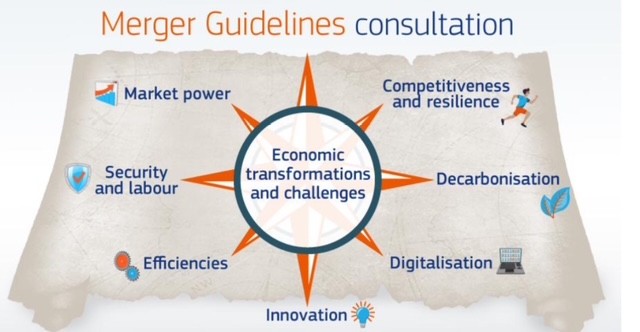
In addition to a “consultation questionnaire”, the Commission published last week “seven focused papers elaborating on a wide range of current challenges and on the legal and economic parameters used in merger control assessment. The papers aim at stimulating discussion and cover topics that are key for the EU economy, namely competitiveness and resilience, market power, innovation, decarbonisation, digitalisation, efficiencies, defence and labour considerations”[2]. Much of the background analysis and the questions are about traditional competition themes: “competitive markets play a crucial role in driving investment and innovation”, resilience requires competition, mergers may reduce the incentives to invest and innovate absent efficiencies etc. But this said, there is also a novel and welcome recognition of Europe’s acute hour of need.
Scale matters
“A reflection is warranted on whether (…) competition policy – notably merger control – must adapt its approach with a view to support start-ups, scale-ups, and medium-sized companies to scale up in global markets” (para 11); “scale achieved through mergers and acquisitions may in some cases help firms become more productive” (para 13). And among the questions: “How should the Commission take into account situations where absent the merger the target company would not have the ability or incentives to scale-up? (A3)” “ What are the characteristics of markets where scale is necessary to compete effectively? (A4)”. How should the Commission assess the benefits of companies’ gaining scale through mergers when they create or strengthen market power? Under which conditions could such benefits be sufficient to outweigh competitive harm? How could the Commission assess whether the benefits of scale outweigh competitive harm? (A6)”. “What would be pro-competitive consolidations in global strategic sectors, such as digital and deeptech markets (e.g., IoT, advanced connectivity, cybersecurity, cloud, quantum, and/or AI), clean and resource efficient technologies or biotechnologies that would benefit competition? (A20)”. Amen.
Investment vs price
Any merger which concentrates market structure and creates overlaps will create upward price pressure absent efficiencies. This is Economics 101. The question worthy of consideration is whether, in sectors which are strategic/critical and where we want to see more investment, we stick to the usual line “concentration does not drive investment! only competition drives investment!” OR we do some serious analysis of whether a particular merger can support investment in a specific industry at this point in time. And/or whether there can be conditions that can be imposed to that effect. We will see what happens to the Vodafone/Three deal recently approved on that basis in the UK. And yes, the economic orthodoxy (Sir John Vickers) described it as “allowing for greater market power to fund investment” – maybe, right? So? If investment comes forward rather it all going into shareholder profit, isn’t that going to possibly offset at least some of the market power in terms of consumer effects?
The consultation indeed asks “In what circumstances can mergers positively impact the ability and incentives of the merged company to invest? Based on which evidence and metrics can the Commission conclude that a merger advances investment? (C7)”. “How far into the future should the Commission look at when assessing the impact of a merger on competition (e.g., whether companies will invest or innovate post-merger, or whether prices will increase because of the merger)? How and under what circumstances should the Commission’s assessment consider long investment cycles in an industry? (C16)”. And more broadly “How should the Commission’s assessment take into account systemic trends and developments unrelated to the merger (e.g., technological developments such as AI, critical or strategic nature of technologies) that may (indirectly) impact the relevant product market and thus the competitive assessment within that market? (C17)”. Amen 2.
Climate and sustainability considerations in the competition assessment
This is really the novel influence of forcing climate change and green transition onto the Competition Church. So here goes the consultation: “mergers may support climate and sustainability objectives and the clean transition and have a positive impact on clean innovation, for example on the deployment of cleaner/greener technologies or manufacturing processes… Mergers can provide companies the leverage needed to invest in the decarbonisation of their activities, cleaner products and technologies, and more energy-efficient solutions and infrastructure” (para 70). And “While merger control primarily aims at preserving competition, the growing interplay between competition, innovation and sustainability considerations across industries and the benefits they could unlock for businesses and citizens should trigger a reflection on merger control’s contribution to European sustainability objectives. In this regard, the methodology and parameters to be included in the competitive assessment to take due account of sustainability considerations, as well as the quantification and verification of ‘green’ incentives and efficiencies, will be key questions” (para 72). Further: “Sustainability considerations may also be part of the theories of harm related to the loss of ‘clean’ R&D and ‘green innovation’ competition (para 74). “Finally, sustainability may also be relevant in the assessment of whether the potential anticompetitive harm of a merger may be offset by efficiencies resulting from it. Positive effects resulting from a merger may compensate the anticompetitive harm” (para 76). Amen 3.
Digitalisation: killer acquisitions, ecosystems, data
There’s some virtue signalling (“we are up to speed”) in the recent obsession with “killer acquisitions” – there have been several when no one was looking, now that this is “a thing” in antitrust circles firms have updated, and they are empirically far less prevalent. But still, worth having it in the books.
There is much explicit discussion of “ecosystem effects” as something to be addressed:
“A common business strategy of leading companies in the digital and tech sectors has been to acquire complementary businesses or key inputs (e.g., data, technology, user traffic, but also talent, compute capacity and others) with the aim of strengthening their position in core markets. Such a strategy may contribute to increases in innovation… however could also have negative effects. By developing or expanding an ecosystem of related products and services, the incumbent may entrench its position, thus making it harder for rivals to enter, expand, or innovate, as they are unable to replicate the breadth and scale of the predominant aggregated offering” (para 84).
And at long last officially moving away from foreclosure as the “go to” theory of harm in these cases:
“…(Need to investigate) horizontal effects of non-horizontal mergers that are not necessarily based on a foreclosure “conduct” but that, given the market structure and market dynamics, as well as the acquirer’s market power, could lead to the strengthening or entrenchment of the acquirer’s position on the market. This may be the case e.g. where companies are not direct competitors, but where the aggregation of their assets, such as data or customers in complementary businesses, would strengthen the acquirer’s dominant position. Another fact pattern where market structure and dynamics could lead to the strengthening or entrenchment of the acquirer’s market position (…) are cases where acquisitions took place within the acquirer’s overall ecosystem of interrelated products or services… concerns include the possible entrenchment of the dominant company’s position on the core product’s market through the addition of a close complement to the core product of that company’s ecosystem of products; and possible effects on potential competition, for instance where the target would have been particularly well placed to enter the acquirer’s markets or where the acquirer buys the target, abandoning its plans to develop the product itself (so-called reverse killer acquisitions) (para 86)”. (By the way I claim credit for coming up with “reverse killer acquisitions”, folks – no question[3]).
And privacy:
“(C)ertain digital mergers also raise privacy and data protection concerns. Competition and privacy concerns can arise when a merger leads to the acquisition of data or the combination of datasets. In some markets, companies compete to gain customers based on their privacy settings, which can therefore be considered a non-price parameter of competition and the merger would eliminate such competition. (…) Privacy concerns can also be taken into account when evaluating the credibility of (alternative) suppliers for specific customers. When suppliers have access to sensitive data, customers might not find it feasible to work with suppliers processing data in servers outside the internal market as this poses a risk of sensitive data being transferred outside the EU. The question is whether these privacy and data protection objectives enshrined in EU law play enough of a role in the market to be taken into account as a parameter of the Commission’s competitive assessment” (para 76). There is a claim this analysis was actually done in Google / Fitbit, though the reality is it was a strong push from the outside with a major campaign – but the Commission did not want to hear about and caved to Google. But good we’re finally getting here.
“Which framework of analysis would capture adequately the effects of digital and tech mergers on competition when a leading company seeks to acquire a complementary business and may entrench its market power as a result? (E6). How should the Commission assess competition risks of non-horizontal mergers that are not based on a foreclosure conduct by the merged entity? (E7). How should the Commission assess competition risks of non-horizontal mergers linked to having a broad range or portfolio of products or services that are interrelated or part of an “ecosystem”? (E9) How should the Commission assess competition risks linked to the merged entity’s accumulation of data? (E10)”.
Democracy – yes, really!
The Brandeisians’ vision that concentrated economic power was a threat to democratic institutions was all too “student politics” for the EC, who loved being seen by corporates as “the adults in the room”. But guess what, it’s creeping in.
“Merger control is primarily focusing on ensuring that mergers do not harm consumers. However, vibrant competition – indirectly – also contributes to other policy objectives and serves as a restraint on the market power of large businesses. Where companies become too powerful in their fields of activities, they may become toopowerful-to-care. Where companies become so large as to be essential they can become too-big-to-fail, and therefore increasingly difficult to regulate for democratic institutions. Research further suggests that mergers can lead to an increase in lobbying activity by the merging firms” (para 111).
Defence and security
Defence gets a shout. Maybe, just maybe with war on the border competition is not the most important thing we should worry about.
“The Political Guidelines of the Commission call for a new era for European Defence and Security, indicating the current Commission mandate will be focused on building a European Defence Union and creating a true Single Market for Defence. In the context of Russia’s war of aggression against Ukraine there have also been calls for further consolidation in the EU defence sector. While it is undisputed that monopolies and monopsonies generally lead to higher prices, lower quality and less innovation, some sectors of the EU’s military supply base are currently rather fragmented. It appears that national autonomy considerations and hardware requirements specific to Member States have so far been the key factors in preventing integration and consolidation in these segments of the industrial defence sector in the EU” (paras 114, 115).
“…whereas security and defence considerations are generally the privilege of Member States, and not part of the Commission’s mandate under the EU Merger Regulation, we are seeking feedback on whether further guidance on the interaction between Member States’ security and defence interests and the Commission’s competition assessment under the EU Merger Regulation could be useful… (including) how to undertake a potential balancing of interests between defence and competition objectives for cases that involve dual-use goods” (116).
Amen again.
Thus, “In light of a changed geopolitical environment and technological advances, the revised Guidelines may provide further guidance on how the Commission assesses cases related to this sector” (para 113).
And finally, labour
“(T)he application of labour market theories of harm may enable the Commission to prevent negative effects on workers in certain specific merger cases. (…). Mergers can significantly impede competition in labour markets by shifting the balance of power between employers and workers. A situation where a single or dominant employer controls the hiring of a group of potential employees is an example of a monopsony. Monopsonies in labour markets can lead to lower wages, higher unemployment, worse working conditions and also lower downstream output and higher prices. While the existing HMG already consider the potential effects of mergers on buyer power more generally, in practice, the Commission has only infrequently assessed the effects of a transaction on buyer power in upstream markets in detail.(…) A key question therefore is whether the revised Guidelines should provide some guidance on the assessment of the impact of mergers on labour markets. An important aspect that the revised Guidelines may provide clarity on is whether an expected significant loss of competition through the exercise of buyer power in upstream markets, including in labour markets, is, in itself, a sufficient theory of harm, or whether instead the Commission also needs to demonstrate that such a loss of competition can be expected to have negative effects on downstream markets (e.g., via higher prices and/or lower output to consumers) (para 122).
Good start, now to the answers
Who will feed into this consultation? Armies of lawyers and consultants all paid by their clients. This will generate a smorgasbord of lobbying and special interests, certainly not all good. Then civil society may wake up to this consultation and put in something with an antimonopoly flavour (mostly about, indeed, “beware not to create monopolies”, something-washing etc.). Borrowing a page from the US antimonopoly book is a mistake in Europe: context is different, the discussion is different, no one listens. The IO academics might (but why would they, if they are not paid) write something reflective of the standard consensus – competition drives everything etc. So far so boring. Citizens will not engage – too long and technocratic for them alas.
So this is an issue. It’s good of the Commission to have raised the right questions. Kudos. Don’t expect too much of this lengthy laborious consultation though. I would rather create serious Working Groups with serious macro and trade and finance and tech people to crunch the issues productively through a broader lens. Not the usual suspects sucking up to DG Comp. Ping me for names. I have a long alternative list.
[1] Review of the Merger Guidelines – European Commission 8 May 2025.
[3] ‘How tech rolls’: Potential competition and ‘reverse’ killer acquisitions | CEPR



 The “Post-Bubble” Blog