
Published NCR, 30 January 2025. Journalist: Marloes de Koning
(AI translated text, from original Dutch)
Cristina Caffarra worked as a competition economist for large tech companies. Now she is trying to break the power of the American and Chinese techoligarchs. “I’ve been as deep on the inside as you can get.”

Cristina Caffarra is one of the driving forces behind a fledgling European movement. Under the name ‘EuroStack’, a loose group of entrepreneurs, academics and politicians are committed to investing in European technology. They want different procurement rules, so that European companies and governments will buy more technology from European makers.
The term ‘EuroStack’ is meant to represent that we have to think in layers (or stacks). So not only look at where the headquarters of social media companies, for example, are located, but also at the layers below; the data centers, the cables, the chips and the clouds. Only if you cultivate serious European players in all those areas can you be somewhat independent.
Caffara is also the organizer of an annual conference in Brussels – which has been called the “anti-Davos” because it is in the same month as the World Economic Forum and because it has the same chic look as the exclusive meeting in the Swiss Alps. But where Davos is focused on networking with top industrialists, this Brussels hotel with high-pile carpet is all about breaking the power of large companies.
This year’s program expresses great concern. Does it still make sense to try to push American tech companies into a European mold through regulation? And does Europe still have a chance at all, between the American and Chinese tech oligarchs?
Becoming more patriotic
Buy European should become the standard as far as Caffarra is concerned. Governments in Europe need to take the lead and become more patriotic with their procurement budgets. “You really don’t have to buy everything in Europe,” says the competition expert, who is familiar with the criticism that the American supply is simply superior. “But start with 30 percent of your procurement budget in Europe. That already makes a huge difference.”
The fact that Caffarra is influential is mainly due to her network, say people who know her. And she owes that to a long track record as a competition lawyer for large tech companies worldwide. She advised Microsoft, Apple and Amazon, among others. And acted as an expert witness before the European Court of Justice in an important case of the European Commission (EC) against Google. “I’ve been as deep on the inside as you can get.” On her LinkedIn profile, she proudly mentions a number of nicknames. Such as ‘Rule breaker number eight’, in a ranking by Politico.
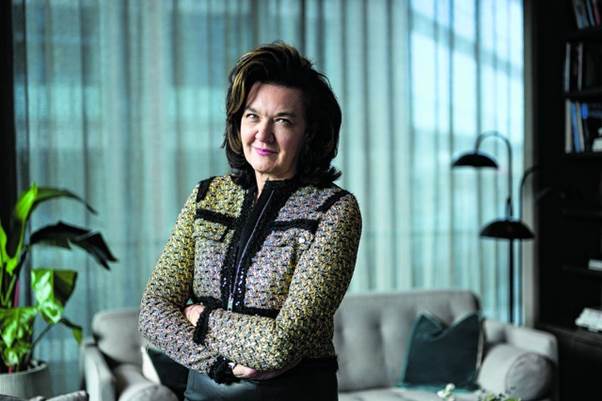
Cristina Caffarra
Cristina Caffarra was born in Italy (she does not want to say when exactly) and lives and works in the United Kingdom. She studied philosophy and obtained a PhD in economics at Oxford. She specialises in competition law and is the driving force behind an influential annual conference in Brussels on how regulators should deal with the power of large companies.
She worked for seventeen years (until 2022) as a consultant at Charles River Associates for large tech companies. Since then, she has been combining different activities. She teaches at University College London and conducts freelance research on economic policy. In addition, it tries to organize unpaid support for investments in the development of a European tech sector.
You used to work for the tech industry. What has changed that has made you think differently?
“Up until the first decade of the 21st century, everything in the digital world seemed new, innovative and liberating. We were collectively hopeful and ignorant. And in the meantime, companies quickly appropriated that new space and grew into the dominant players we see today. By the time we timidly started some competition cases after 2010, they had already nailed everyone down. In the search domain, in social networks, in e-commerce, in app stores. Lawsuits such as the EC’s against Google’s monopoly on the search market were conducted with the best of intentions. But they lasted for years. And while such a case was running, Google continued to grow and the company also became the dominant player in the field of mobile phones. The business was in fact pointless, because the horses had long since galloped out of the stables.
“At that time, it dawned on me: a high billion-dollar fine makes for nice headlines in the newspaper, nice for the European Commissioner, but does not make a company behave differently. I found that hard to watch.”
That realization also dawned in Brussels around 2018, Caffarra describes. And it led to better legislation. Instead of just fining afterwards, for example because a company had favored itself in search results, rules were introduced that stated: you may not favor yourself. A European privacy law was introduced. And a few years later, political agreement was reached on the Digital Markets Act (DMA) and the Digital Services Act (DSA). “Very good; and the Americans never succeeded. But the question I keep asking, and I haven’t made myself popular with that, is: how is this going to work? So far, it has had no impact.”
Understanding the algorithms
Caffarra uses practical examples to explain why the evidence against large internet companies and their algorithms is actually too complex to conduct lawsuits that cause them to behave differently. To demonstrate that Amazon, for example, promotes its own products, insight is needed into the algorithms and the way they have worked at different times and in different places. Even while that investigation is ongoing, Amazon’s smaller competitors are dying. Can you prove afterwards that they went bankrupt because Amazon’s algorithm didn’t give them a fair chance? Or can Amazon argue that those other parties had a lesser product and would have outcompeted anyway because users don’t want them?
You can’t figure it out legally, she argues. “It has become a ritual dance.” Whereby, she says, “the companies come to the regulator and ask what is wrong again. The regulator puts a problem on the table and they say, oh, okay, we’re going to think about it here at home in California and get back to you in a few months with some minor adjustments.”
What that means, according to Caffarra: “At most, you get adjustments in the margin. Be less brutal to sellers, a bit nicer to developers in the App Store. Making applications a little more interoperable. But what really matters is power. Established power of a dimension and quality that we have not seen before. Regulation cannot solve that.”
The EU hopes so. Washington and Silicon Valley have now embraced each other and in Europe we are especially proud of the DMA and DSA laws.
“That’s the biggest delusion of humanity, sorry, but I have to say it. Of course, our legislators have no choice but to say that they are going to enforce laws. But let’s take an honest look in the mirror. Even before Trump, that was toothless. How does the Digital Markets Act ensure that there are more opportunities for small and medium-sized entrepreneurs in Europe? Not.”
With the DSA and DMA, fines of 6 percent of a company’s annual turnover can be imposed. Quite a lot, right? Do you see that happening?
“Europe has been struggling since those laws were passed. We were lulled to sleep by the Biden administration, because it seemed so warm and friendly and so thinking the same as we did. In the meantime, no one was planning for this American election result. And now it has become much more difficult and they are swirling like leaves in the wind, with statements about how great the rules are in Europe. And in the meantime, since the beginning of November, they have not dared to publish the fine decisions against companies that violate the law.”
You are now talking about fines for Google and Apple, right?
“Google, Apple, Meta, everyone. Something happens in the background, but everything that is said is very weak and conciliatory. I understand that Trump is big and frightening and his administration is a tech oligarchy. Look at those iconic images of the inauguration, with all the heads of tech platforms next to each other and at all the pilgrimages of tech bosses to Mar-a-Lago. There they heard from Trump ‘feel free to be your worst self, I support you’.”

What do we trigger when the EU imposes a billion-dollar fine on a large American tech company? What can Trump do on the digital battlefield?
“Few people realize that 80 to 90 percent of the digital infrastructure belongs to non-European players, mainly Americans. The legislation also focuses on apps and services that consumers have to deal with. The search engines and the web shops and social media platforms. Wonderful, the DMA and the DSA, but they do nothing for what lies beneath the surface. If you stop and think for a moment, you can see the infrastructure, from chips to data centers, from clouds to network connections.
“If our roads, water, our electricity, our trains and our airports were largely in foreign hands, we would find that unacceptable. We let that happen because it was faster and easier. And because Europe is fragmented. If you want to store data safely and cheaply as a medium-sized company, you go to AWS [Amazon] or to Microsoft Azure. Not to a European cloud provider.”
These are all private companies. How does that fact give an American president power?
“That is the question. Who owns the kill switch [the button that turns everything off] for this infrastructure? There is a safety risk due to dependency.”
The fallacy, Caffarra argues, is that Europe focuses almost exclusively on stimulating research and innovation at the university level. “But that does nothing for our productivity. The only three large European hypercomputers, in Barcelona, Bologna and Kajaani in Finland, are for universities.”
Isn’t that a good thing?
“Not at all. The researchers come out of my ears. The next step is missing. The one where an idea becomes a product that sells. When Europeans have an idea for a product, they emigrate to the US, because that’s where they find funding for their start-up. There is a huge exodus of talent going on.”
This week, the EC proposed to include a preference for European companies in procurement rules for essential sectors and technologies. Did EuroStack get what it wants?
“Absolutely not! It is fine to make it mandatory that there is a preference for ‘European’ in tenders. But why only in governments? And in the meantime, European governments are not behaving accordingly. They all use Microsoft Teams themselves. And the European Parliament has just given a large contract to the American company Anthropic for ‘AI tools’ that European companies could also have supplied. They are speechless.
“We don’t need any more attention and subsidy from the European Commission for R&D. We need to move to the next step: showing that ideas can be produced and disseminated. We need entrepreneurs and therefore financing. In Europe, it is still far too dependent on banks; They think in terms of mortgages and real estate, not loans to young entrepreneurs. And so people pack their bags and leave. ”
So what do you propose with EuroStack?
“Don’t put all your energy into regulating the giants. Those laws are not wrong, but they do not add points to your GDP. Europe needs major investments in European digital infrastructure. Built in Europe, sold in Europe and in European hands.
“I don’t suffer from delusions, I don’t think we can replace the big platforms. We will no longer be able to control that infrastructure 100 percent. But it would be a great result if we could keep at least a piece of the market for ourselves. It would already be a huge achievement if we could meet at least 30 percent of our own needs in Europe.”
We have so many talents, we can do so much, we are so rich. But it is shrinking
Cristina Caffarra Mededingingsexpert
Your expertise is competition. Can we play by the rules and at the same time do ‘Make Europe Great Again’ and buy partly European?
“Competition rules are not a bible. Something is not going well when those rules paralyze your industrial policy.
“We are not proposing that all digital infrastructure should be in state hands. That is also possible, but that is another issue. But you have to listen carefully to what European entrepreneurs say, namely: ‘I don’t need subsidies. I can invest myself. As long as I can reasonably be sure that there is a demand for my services.’ And the state can lend a hand by having companies and governments, for example, purchase 30 percent from European suppliers. It is unbelievable that governments throughout Europe – with the exception of the French – use Microsoft Windows and Teams, while there are European alternatives where our data is much better protected.”
Are you saying that we should become more patriotic? We find that a bit complicated in the Netherlands. Possibly because we associate the heyday of our country with colonialism and slave trade.
“Absolutely. There is nothing wrong with patriotism. In Europe, those kinds of terms are often associated with the extreme right, but I don’t see it that way at all. I look at the US, where I have also lived. You can just be proud of being an American and want the best for America, regardless of whether you are Republican or Democrat. We must not allow such terms to be held hostage.
“I like being in America, but at the core I am a European. And it hurts to see how fragile and vulnerable we have become. We have so many talents, we can do so much, we are so rich. But it is shrinking, because we are so fragmented and because of a lack of vision. We need to get to work and put Europe first. But we are late. Terribly late.”
Speaking of colonialism; Have the roles been reversed now? Europe as a colony for the Americans who skim and exploit our data?
“The infrastructure that collects, stores, uses and operates data is mainly American. And we don’t have an equivalent ready where we control that ourselves and where it happens according to our norms and values and ideas about privacy. We have privacy rules, but no one cares. Don’t think that Google is there to help us by building data centers for us. We have to do something European ourselves in order not to become a vassal of the US.”
Read the article here


 The “Post-Bubble” Blog