
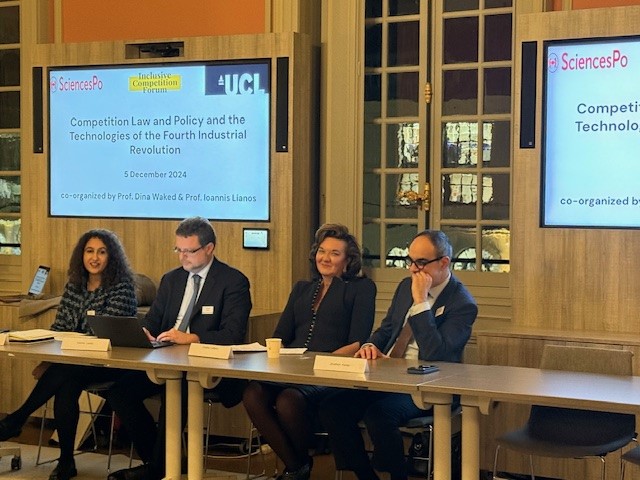
Science Po/UCL/OECD event Paris, 5 December 2024


What is foundational in what we see around us in AI is that the same companies under investigation in dozens of jurisdictions for anticompetitive conduct across the “digital stack” are “leading the charge” in genAI investment and deployment
Yet somehow we behave as if “AI” is a “different thing altogether” – infused with “magical powers” which will lift our doldrum economic performance if only allowed to deploy at speed
Even Draghi has been infected by this enthusiasm and warns repeatedly in his report about not missing out on the “promise of AI” as the key to European digital prosperity closing the productivity gap etc.
But:
- There is no “AI stack” distinct from the “digital stack” – it is the same the supply chain from chips to compute to connectivity to cable under the sea to lakes of data – that is used to power all of our experiences online – all apps and services. So the idea that there is some “special sauce” in AI that justifies it being treated like something different and unique is not right
- The reality so far seems more prosaic in that yes individuals/ organizations are outsourcing long documents or email tasks to AI but there is not much system change. Personal efficiencies rather than organisational gains, incremental productivity gains for individuals – shaving time off boring or difficult tasks and workflows
Yet we are in a nonstop cavalcade of Big Tech hype and diversion and obfuscation. Multiple distracting narratives:
- Started with the “doomsday scenario”
- Then evergreen pushback “but China” “(if you come in the way of us doing what we want, you are an enabler for China!”)
- Supporting safety and regulation early on at the downstream leve (productization) to distract from the locus of power – upstream, with the Usual Suspects
The reality is the power is upstream and is nothing distinct or different from the intractable power we are faced with now in apps and services – search, social networks, etc. It is manifesting itself in multiple ways:
- Bundling and tying – through embedding of functionalities into productivity applications – with price effects (Microsoft’s productivity suites, Copilot)
- Monetization through conventional personalised advertising – OpenAI announced it is going into personalised advertising in response to queries to chatbots – with each query potentially an opportunity to serve an ad
- Agreements and acquihires as circumvention of merger control. We are being played. Agencies tell us about complexity and their efforts to “explore” whether agreements involve exclusivity etc. Reality is these agreements are lawyered to within an inch of their life and they are deliberately designed in this way. Pointless to rely on conventional theories of harm: increase of market power, exclusion. Instead we should be formulating the theory on what is really going on: “AGGRESSIVELY WEAPONIZING SCALED ASSETS TO GAIN FIRST MOVER ADVANTAGE IN ADJACENT INCIPIENT MARKETS”. This should be our theory of harm. We are admiring the problem as usual.



 The “Post-Bubble” Blog