
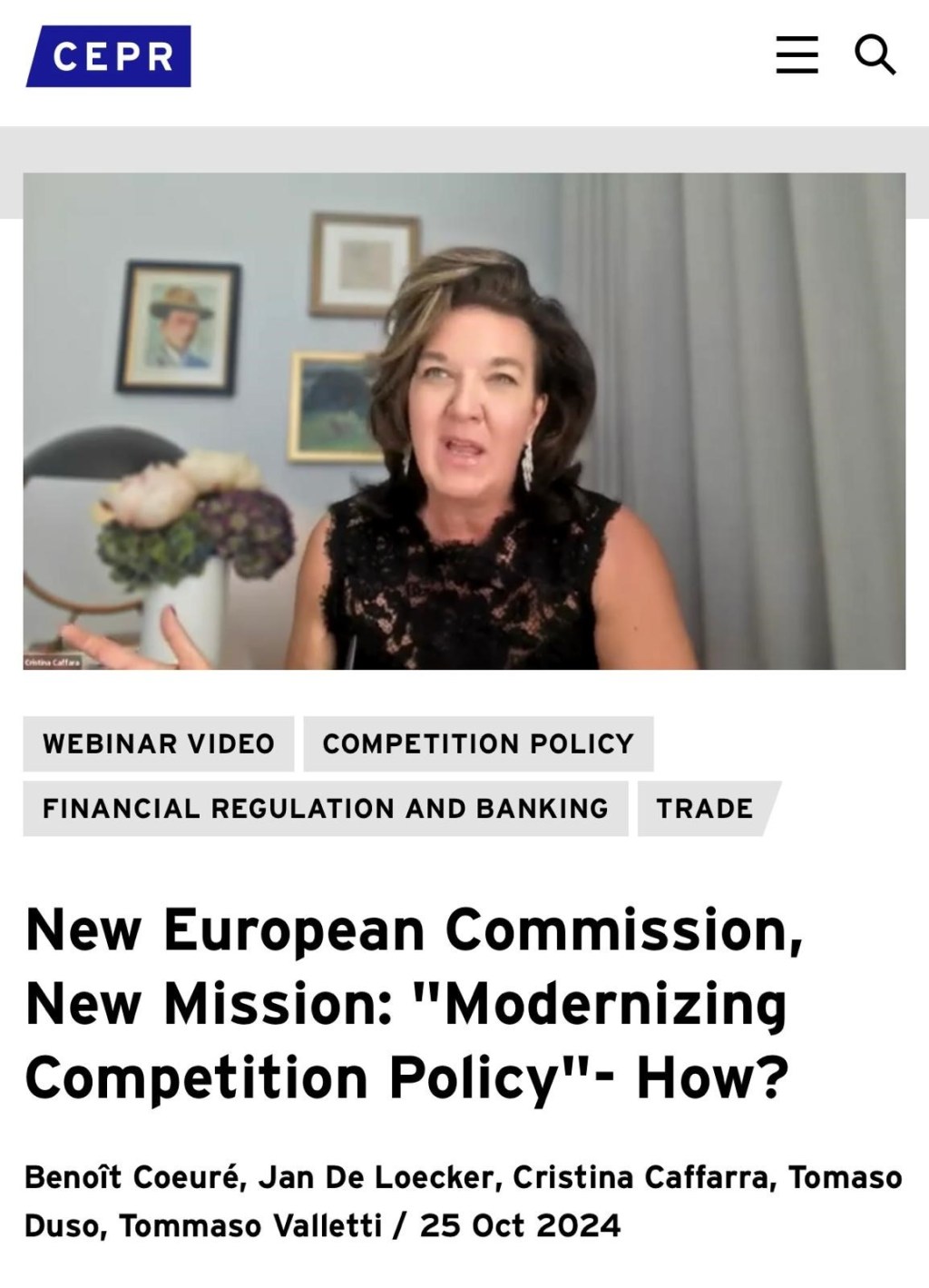
SPEAKERS
Benoît Cœuré, Cristina Caffarra, Nils Redeker, Sander Tordoir, Jan de Loecker, Tomaso Duso, Tommaso Valletti, Alexandra Geese
Tommaso Valletti
[Welcome]
Cristina Caffarra
[Welcome]. I will frame today’s topic briefly before getting to Benoît. I personally have been “a loud caller” for some time for “joining the dots” between competition policy, trade and industrial policy. And now Draghi comes along and says (p. 9 of his report) “industrial policy, competition and trade policies need to interact closely, must be aligned as part of an overall strategy”. This is a call from him to work economic policy tools together, instead of the current way in which we have competition policy siloed literally in a tower, trade siloed in another place, and industrial policy pretty much nonexistent at European level, but at member state level. Draghi says (as we all know) we have a massive problem with growth and productivity, and many reasons for this, but we also need to work these tools together; and indeed, in designing the incoming Commission, President Von Der Layen has pretty much distributed competencies across DGs and Commissioners and mandated Commissioner Teresa Ribera to “modernize competition policy”. The response of many in the competition community has predictably been defensive: “We don’t need change. We are already doing everything right. Beware the slippery slope, Pandora’s Box, politicization of antitrust, “national champion” trap! Draghi wants to soften merger control. Oh my God, this is terrible!” We are fortunate to have Benoît Cœuré as our first speaker. Benoît is not only the President of the Adlc, the French Competition Authority, but also nominated as chair of the Competition Committee of the OECD. We’re fortunate because Benoît has been one of the very few heads of agency, senior competition enforcers who has actually engaged with Draghi’s message, so it’s particularly important to hear what he has to say today. Over to you, Benoît.
Benoît Cœuré
Thanks, Cristina, for your nice introduction. […] As Cristina pointed out, the Draghi report is more than a simple list of recommendations for the attention of the next Commission. It calls for a change of paradigm in the design of European economic policy, namely, moving away from the traditional silo approach of competition and trade and industrial policy towards a unified approach – or you could call it a “whole of government” approach, only I don’t do that because it’s very US-focused, and we are not the US. But I think the meaning is there should be a unified strategy that is fully geared towards supporting competitiveness and innovation in Europe. So that’s a pivotal moment and Draghi himself hasn’t been shy of saying that he sees it as a last chance for Europe to catch up with the US and to preserve its economic and social model. So the stakes are extremely high, and to my mind, there is no doubt that competition policy and competition enforcers should play their part to meet the challenges.
So, before the panelists step in, I would like to say a few words on a on a key learning of the Draghi report, which is that industrial policy and competition policy should not be seen as enemies, but rather as two sides of the same coin. And that’s far from being self evident, as we all know for the past few years, maybe, in fact, for many years, there has been a rather divisive debate in the EU on the relationship between competition policy and industrial policy. Advocates of industrial policy have been blaming competition for preventing the birth and rise of European champions. That’s an anecdote, but when I was appointed head of the French competition authority, wherever I would go in Paris there were only two words I would hear – Alstom and Siemens. That summarized the whole discussion for many in the French elite, be it the corporate elite or the administrative elite, there was this accusation of standing in the way of national champions. The competition community itself has been sticking to a strict interpretation of their mandate, for fear of return to what they see as the old competition policy driven by politics and by national interest. To Draghi’s credit, he acknowledges that this standoff is a dead end for Europe and that we should move beyond it. So the first thing that we can learn from the Draghi report is that competition should not be blamed for the slow decline of the European economy. There are plenty of other culprits, ranging from the lack of integration across many markets to insufficient investments in innovation.
Second, there is no effective industrial policy without competition. Industrial policy is meant to foster innovation and for innovation to bloom and to flourish, we need fair and open competition, or to put it differently, if we want our companies to confidently move to the international stage, they should first be ready to compete at home. Competing at home is the way they will build competitiveness, to then compete on external markets. And this can only happen if they can compete on their merits, and that’s the job of DG and national enforcers. So competition rules are meant to offer a basis for industrial development, not to impede it. One way to summarize this, all of this, is to say that competition policy is industrial policy. Against this background, I fully support what I see as a reasonable approach put forward by Mario in that competition law should accommodate a more proactive industrial policy. But without losing its soul in the process, we can achieve both the consolidation of European industries and robust competition. Achieving both is both doable and desirable.
Then the question is, how do we get there? That does not mean that competition policy should yield before other policy imperatives. I read somewhere a comment suggesting that Mario Draghi’s report was saying between the lines that we need competition, yes, we need competition, but only the right amount of it. So, let’s call it the Goldilocks approach to competition policy, right? I don’t agree, competition policy does not need to cool off. Rather, it should. strive to be effective, and it should be mindful of other policy objectives. And if it’s better, then why not more of it?
Another important point made by Mario Draghi is the unnecessary fragmentation of the EU’s regulatory landscape, and as we know, he gives a few examples, telecom, finance, energy. Market integration stands as the unfinished project of the EU and competition enforcement is hardly to be blamed for it. It’s an entirely different discussion. So regulatory fragmentation, more than competition policy, stands in the way of creating European champions and market definitions, which are often being waived by politicians as a way to change the dynamics. Market definitions are an outcome. They’re not a policy instrument. Market definition is a tail that wags the dog.
In addition allocating state aid on a national basis runs counter to single market objectives – and integration, and even more so, when 80% of it goes to two countries. Well, you can guess which are the two countries – I’m sitting in one of them. Hence Mario Draghi proposal to prioritize state aid, or to channel state aid to EU wide projects such as such as IPCIs, all may sound quite removed from our priorities as competition enforcers, but it’s not. We have an existential task in making industrial policy works and is pro-competitive. And if we’re not part of that discussion, we won’t like the results, so we better be part of the discussion.
Maybe one last remark before moving to more practical questions. I’m an econometrician by training, and in econometrics it s often the case that if a model is misspecified, it’s because there is a missing variable, and the missing variable in the competition vs industrial policy dilemma or conundrum is international trade. It’s the external border of the EU and I’m also grateful to Draghi for making this point very clearly, politicians often mistakenly believe that competition policy can be weaponized against foreign companies, either through antitrust enforcement or through merger reviews. So I’m a hero in Paris when the authority fines Google for abusing dominance, and I’m a troublemaker when I block a merger between two French companies. There has been progress, for instance the introduction of dedicated instruments to tackle some trade policy challenge. The foreign subsidies regulation, for instance, the anti subsidy mechanism in public tenders, or the revival of the anti dumping mechanisms, these are also ways to protect competition, with the objective of having a level playing field assigned globally to trade policy instruments, not to domestic competition policy instruments. That’s the right assignment. And that also makes a broader point, which echoes what Cristina has been saying on the need for competition authorities to come down from our ivory towers.
How do we map these nice principles into our daily decisions? That will be the important challenge for national authorities, and even more importantly, for DG Comp and the Commission under the new commissioner. So let me highlight a few questions, a few examples of these practical issues that we need to discuss in the coming months.
My first question is about merger control. Competition enforcers are encouraged by Mario Draghi to accept investment and innovation defenses when reviewing mergers and at the same time to reinforce ex post monitoring. The legal framework already allows us to do it, so the question is about the kind of safeguards that we want to see in place if we want to make it work. And maybe some of us, some of you, maybe, will say there are no possible safeguards and it’s never going to be possible. But I think we have to look in good faith at these safeguards and see if it can if it can work.
The second question is about sustainable development objectives, and that’s in a way a variant of the first one, because it’s also about efficiency defence. A lot of us believe that sustainable development objectives should be better factored into a competition analysis, and that’s not only in merger review, but also in cartels and maybe in abuse of dominance, even though that discussion is less developed. Can we? Can we accept a sustainability defense without opening the floodgates of greenwashing? Can we agree on a methodology to assess environmental efficiencies? The Dutch ACM has been a pioneer and blazed the trail. But can it be agreed at the European level? We know that if we’re discussing environmental projects, a lot is about externalities. So there will be out-of-market externalities, and it’s a long discussion among enforcers how much we can take them on board. And there are other questions related to the time dimension and to discount factors, like how can we trade future environmental gains against short term welfare losses, for instance, and what’s the discount rate? So these are very practical questions that we can discuss.
Third question is, Draghi said that we should accept more investment innovation defenses and reinforce ex post monitoring. So enforcement should be lighter ex ante and tougher ex post. That’s a way to summarize a number of propositions in the Draghi report. Let’s give a chance to business, and then if we find we don’t like the outcome, we come with a big stick. That makes a lot of sense. There is a widely held perception that we’ve been sleeping at the wheel, and we’ve been too late to react to some developments, particularly in the digital field. But how do you square this undertone of the Draghi report with the lessons that we’ve learned from the past, in particular in the digital field, that’s an open discussion.
And finally, coming to our industrial policy, how can we put flesh on Mario Draghi’s proposal for a competitiveness coordination framework, quote, unquote, what does it look like? And here you have a number of governance issues like, how do you allocate state aid at the European level, rather than just reacting to demands put forward at the national level? And how do you evaluate, how do you decide on priorities? That’s a governance discussion at the European level.
There are also deeper issues, such as how do you develop the common industrial vision when the preferences of member states are so diverse and sometimes very idiosyncratic. How do you consolidate, how do you aggregate these preferences? We don’t know, and that may sound particularly difficult at a time when the political fabric in Europe is wearing very thin. That will be a key question for the next Commissioner and DG Comp. How can you act effectively to aggregate preferences across Member States at a time where preferences are diverse and Member States don’t really want to talk to each other. How would we formulate the political challenge here. So well, there is plenty here to discuss. There is plenty for competition enforcers to disagree on, and we need a lively discussion. We need to and I’m grateful again to Tommaso and Cristina for starting that discussion. My conviction is that shying away from that discussion would be at our own risk. So competition enforcers or competition authorities can ignore industrial policy, but industrial policy will not ignore them, and I stop here.
Cristina Caffarra
Thank you so much. Benoît, a wonderful introduction. You are uniquely candid and engaging in this debate, with a series of big statements (“competition policy is industrial policy”, “we have an existential stake in getting it right”) to a number of practical questions we need to address. Let me now move to the next discussion. The Draghi Report, and it’s been much discussed, emphasises scale and the discussion has been on whether he really means we need to relax enforcement and merger control. In fact he’s made very clear in subsequent discussions that ultimately he is not in any way suggesting any relaxation or any rolling back of enforcement. He is clear that competition is super important, and has several recommendations in the competition chapter of his report. So let’s take this as read AND focus instead on the message of joining the dots between competition, industrial policy and trade. What does that mean? Benoit you were not too willing to use the “all of government” interpretation, because it is an American rendition of the idea, but I like it and I think it is very much what Draghi implicitly is referring to: how can you continue to operate in the current world competition policy in a silo, without changes like we got the right way of thinking about it all the time ago, we got the right tools and the right techniques and we don’t need to be cognizant of the evolution of the economic environment and the political economy. We have gone in a very short period of time from a world of laissez faire, open trade, neoliberalism, hyper globalization, where China absorbed much of our exports, to a post COVID world in which we have tariffs being imposed to protect us from a tsunami of Chinese over production, Europe is much more dependent on export to the United States and so on. These are massive changes in the global landscape, and we cannot be ignorant of these when thinking about competition policy and how to deal with markets. We can’t just say “we do competition over here, we define markets the good old way, we have a box of tools, we hone them over the years with efficiency as the goal, and we apply them to all markets and cases. And we know what we’re doing, and we’re doing just fine”. But the vision that was prevailing of trickle down, markets know best, efficiency as our main driving force failed.
And on top, along comes Draghi and he says, “whatever you’ve been doing over there in competition doesn’t seem to be helping the mission very much”. How does competition enforcement in Europe play with the other tools to help us get out of our predicament? Surely we’re not too tough on mergers, we are practically a merger factory. I think the number is 4000 mergers in 10 years, of which only nine blocked at the Commission. So it’s not as if we are too tough, nor is it the case that conduct enforcement has been particularly effective. If competition policy is going to support the mission in Europe, we need collectively to become more cognizant of the global forces that shape markets, and also much more engaged in supporting industrial policy.
Now I hand over to Sander Tordoir chief economist at the Center for European reform. Benoît mentioned trade, and you have been writing about the production and trade landscape going through. Indeed, the major changes I described – COVID, big shifts in trade flows, tariffs. On this platform last July we had US Trade Minister Katherine Tai setting out how the Biden administration trade policy was aligning with antimonopoly values and had abandoned efficiency as a guiding principle. Draghi warns that other blocks are not playing by the rules, while in Europe we’re still sticking to the old Washington consensus of open, free trading economies. You’ve been saying we’d better wake up. You’ve been writing about how Europe and Berlin are behind in appreciating this new landscape. So please go ahead tell us how you see these big, consequential changes that are underway, in particular changes that competition regulators in key strategic sectors should not be ignoring and should be informed about.
Sander Tordoir
Thank you, Cristina. And it was indeed a pleasure to listen to Benoît. So I thought I would talk a bit about the trade in in green tech manufacturing, which is my lens onto the world, then describe the changes you were referring to Cristina, and then lay out what I think are three major consequences for Europe if we don’t act, and three principles that I think align nicely with the Draghi report.
If you look at Europe’s green industry, it is actually quite powerful and it is promising. We are behind in a few areas like solar panels, car batteries and to some extent, in electric vehicles, but in many areas that matter for the move to an electric future, we are actually not – if you look at machine building or turbines of all sorts, Europe is is globally, quite dominant, in fact. And so if you take the wider swath of low carbon technology products that the IMF has a nice database on, and look at Germany, exports of these types of products are already 4% of German GDP, which is twice the second G7 country, Japan. The EU is actually leading in green patenting. So both on the innovation and the production side, there is hope for European green industry coming around, and trading green tech is growing rapidly around the world. With one important exception, which is China. So if you look at low carbon tech trade, there is a massive import compression is happening in China. Exports are way up. They seem to be closing off imports.
And of course, that’s part of a wider story of the Chinese economy, which is re unbalancing and basically exporting its imbalances to the rest of the world. Private household consumption only makes up around 40% of China’s GDP, which is an exceptionally low level even for high savings Asian economy. And so after the global financial crisis, we had a phase where China’s property sector basically absorbed a significant portion of these savings and were put to work at home. But now that has ended, the real estate bubble popped. China’s real estate sector is expected to be cut roughly in half. And it is no accident really, that the crackdown on China’s property sector has coincided with a very large increase in China’s trade surplus, in manufacturers and in particular, also in these green tax sectors. So if you look at China today, its manufacturing surplus is now a staggering 10% of its overall GDP. It’s just a huge shift in global goods trade flows, and there is, of course, also an industrial policy story here. It’s China’s increasing technical sophistication, but also the political commitment to subsidize advanced manufacturing and draw on global demand to make up for weakness in internal consumption. And that’s a challenge, really, for all major advanced economies, not just the US, also very much for Europe, we retain a strong production base in clean tech sectors, but also cars, machine building and airplanes, and China is basically set poised to take a dominant share of of the global market in an ever expanding set of industrial sectors.
Now that brings me to the consequences and the interplay with the competition debate. There is this narrative that we should just accept all these cheap Chinese imports because it’s great for the green transition, right? And that may be true in the very short run, but in the long run, it is quite distortive. Because it means that our manufacturing sector will shrink much more than it has to if we genuinely had free trade, which we don’t, in this case. And so let me just lay out what I think are the three main consequences of not responding to the Chinese bag of policies.
The first one’s obvious, if we do not pursue our own industrial strategy, we will import China’s strategy, and our dependence on Chinese supply chains will grow wider across more sectors and deeper within each sector. The second consequence is our manufacturing base will shrink, and that has repercussions for European productivity. So EU manufacturing productivity growth was around 1.7% a year in the 2010s compared to below 1% for services. The tech sector is better, but the tech sector in Europe is relatively small compared to the US, roughly half. So there isn’t much hope that we can basically offset the loss in productivity and manufacturing with tech, at least in the short run. The third consequence, in my view, is that innovation may actually also decline. We know that monopolies tend to undermine innovation, but overly competitive markets with lots of dumping and too much downward price pressure also undermine innovation. And it’s quite simple. If our firms can no longer invest in the next generation of machines and production methods because their profits and revenues are under too much pressure, then they will lose out on making the next jump to the technological frontier. And we know from American research on the first China shock in the 2000s that patenting in the affected industries declined by 40% or 40% of the patenting decline was because of China shock. I’m really concerned about that. That would mean that again, Europe is the most innovative green tech manufacturing hub in the world. If patenting would decline, that would be bad for our green transition, but actually also for the Global Green transition.
What can we do about it? I think there are basically three principles. The first is that there’s obviously a trade off between producers and consumers. So if you think of industrial policies, as Benoît said, and you think of other policies, like competition policy, you have to think about to what extent do we support our producers, and to what extent do we basically transfer some rents from the consuming to the production sector. You don’t want to do so across the board, there may be areas where you just want to accept cheap imports because we have no industry like solar panels like Draghi says; but in other areas you may want to make sure that we regain or retain competitiveness.
The second and related observation I would have is that you have to think of sectoral shades of gray. That’s also very much, I think, the Draghi blueprint. So move away from a yes or no debate on industrial policy to a nuanced “how and when” discussion and there, the contrast with cars is significant. Solar PV mean 20,000 jobs in Europe, we have half a million jobs of people installing solar panels, we have millions of jobs in car manufacturing. The EU is already a net exporter of electric vehicles, and so there is a real shot that you can actually make that transition work, and a real interest in terms of having an employment-rich sector remain competitive.
The third observation I would have is rely on firm neutral instruments. You want to avoid regulatory capture, and we have such instruments. Tariffs are fundamentally a firm, neutral instrument. Also, if you think of R&D spending like the Dutch are doing now in the South of the country, to let the ASML semiconductor cluster grow, creating infrastructure, investing in universities, that should be uncontroversial. But also, if you think of a European industrial strategy, and you think of the EV discussion, I find it quite remarkable that we don’t have a European directive whereby every country that does subsidize consumers to buy electric vehicles needs to align on the conditions that we set there. Some countries, in fact, actually hand out another subsidy to an already heavily subsidized Chinese car. Others, like the French basically have climate conditions built in to make sure that it’s built in Europe. We need to think about these types of things.
We need to make sure that we don’t only look at the European market in isolation, but think of the European market within this globally changing landscape. And if you see markets that are tending towards oligopolies globally, you may, in fact, be better off as Europe to create larger firms of your own that can compete. Airbus is the classic example in the past where that happened, and the European said, we need some industrial strategy and coordination to make sure that we don’t lose airplane manufacturing in Europe. And the larger observation I would have there is that it’s probably safer to do so in markets that are already Europeanized, like the goods market which is more integrated than services markets, so there’s less of a risk of creating a shark in a small pond. You can create a larger shark, and it will face competition from other European countries and from the global scale. I think that’s the kind of logic that I would go for. Now, of course, I would echo Benoît’s comment that the fact that European markets are still fragmented is the really big problem, we want firms to be able to grow organically, and that’s hard given all the barriers we still have. The IMF recently estimated the barriers in the single market in tariff equivalents, and it’s 44% for manufacturing and 110% for for services. So we have very, very very significant barriers, and bringing them down is probably the best thing we can do in addition to having a more compelling industrial strategy. Thank you.
Cristina Caffarra
Thank you. One thing you said that you share also with Benoît is the mention of trade offs, I have said for some time that we need to consider more explicitly that tradeoffs are at play, and when we are thinking about enforcement we need to be thinking about trade offs more explicitly. I now want to bring in Nils Redeker Deputy Director of the Jacques Delors Institute. Industrial policy in Europe is not like competition or trade, “one stop shop” in Brussels, it’s firmly in the hands of national governments. Brussels only has state aids to play with, but Draghi has this vision of a much more muscular industrial policy with a lot of capital behind. How is this going to come about, and how should competition policy be useful?.
Nils Redeker
Thank you, and thank you for the invitation. It’s great to be here, and I’m already learning a lot from this discussion. I wanted to start by marking out again, what I think is one of the key contributions that the Draghi report made on industrial policy, really clarifying the choice before us. A lot of the economic policy debates have often been on “should we do industrial policy or not?” And then theoretical arguments in favor of doing so, and theoretical arguments against it. And the empirical evidence is mixed, and you end up with a debate that is quite abstract and quite stale. What Draghi points to is that this framing is off the mark. First, because industrial policy has never gone away, and whenever you looked under the hood, you could see it at play in key sectors. And second, for all the reasons we mentioned now, climate policy, geopolitics, competition, it’s bound to take a more central role.
So the key question here is not, are we going to have an industrial policy or not, but are we going to have a coherent joint, EU, wide industrial strategy, or are we ending up with 27 different national industrial policies that are scattered across different policy fields and policy objectives, and in the end, in competition with each other. This is the question we’re facing. How do we push towards this first coherent scenario? Three things I think need to be addressed in this.
The first one, and Draghi is also quite clear on this, is that the challenge is before we have industrial strategy, we need to understand or make a decision on what sectors we want to have industrial policy for, which sectors do we prioritize, and why? And the reason is that industrial policy comes with trade offs, so need quite a good understanding on what we’re doing here and why. And this is quite a basic point, but I think it’s important to emphasize that EU is not there yet. If you look into the different documents that the last Commission has published around its own industrial strategy, only in the last term, you will find that there are more than 50 technologies and industries deemed to be strategic there, and they range from heat pumps and solar panels to robotics and biomonitors. And the issue with this list is not just that it’s quite long and it looks a bit random at times, it’s also that it mixes together industries where we have very different objectives. So take the example that Sander already gave on solar panels, the objective really here is to diversify supply, reduce dependence on China. This requires a very different kind of tool set than supporting an infant industry like hydrogen, where the idea is that we can build a dynamic competitive advantage in Europe. These are quite very different industrial policy goals, nonetheless, in the EU, they are mixed together on the Net Zero industry act, and are treated with the same kind of policy tools. And I don’t think this will work. So first of all, we need to have a discussion on what are the sectors we’re trying to target, why are we targeting them, and what are the objectives we’re trying to achieve here.
The second point is that industrial policy needs a lot of coherence across different policy fields. And not all. Industrial Policy is about subsidies, and in many instances, things like trade policy, regulation, public procurement are much more important. This also means that if you are committed to supporting a certain sector for strategic reasons, you need to make sure that different policy levers are all pulling into the same direction. And again, we have an issue here in Europe in achieving this. Again EVs are a good example. I think the Commission was completely right to impose countervailing tariffs on EV imports from China in order to provide European producers with some breathing space to build competitiveness. The signal is, we want a home grown EV industry in Europe. But on the other hand, we are introducing policies that work against this. On the regulatory front, the last months have influenced a lot of like uncertainty on whether we are actually serious that EV is the way forward, or whether we let combustion engines continue. The same goes for some of the national purchasing bonuses schemes, where they have ended at the moment, where demand is already low, and so we are imposing tariffs now, at the moment where EV demand is dropping quite rapidly across Europe, and this is a bit of an example of kind of a half baked industrial strategy, where the trade level is signaling one thing and the other levels are basically saying, well, we’re not actually that sure. This can be an issue, the cure actually is worse than disease. So we need to decide on sectors, and then we need to streamline our different policy tools to make sure that we are really coherent and not what we’re trying to achieve.
And the third big challenge, and that’s to a certain extent, unique to the EU context, is, how do we deal with national state aid, and how do we make sure that National Industrial solar policy efforts do not undermine fair competition in the single market and lead to economic fragmentation. I think the pragmatic way forward here is to be quite clear that we are unlikely to see a big new European fund for industrial policy making it soon. That means in the short term, we will quite likely see more national state aid, and what we need to achieve is to make sure that any kind of national state aid we give is tightly squared into European frameworks that make sure that national state aid actually works in European directions. So this means I probably would like to see more things like the hydrogen bank services models, where you have a European framework that is funded by national contributions. This is the short term, and then in the long run we need to have a debate about a real European competitiveness fund that cofinances some of these projects or programs, in order to make sure that fragmentation doesn’t become an issue in the medium term. For that, we need to have a real debate. But I think this debate quintessentially starts with the negotiation of the next budget. So now a bit, but then really in 2025.
So three things. First, strategic choice. Second, harmonizing our policy goal levels. And then third, come up with a shorter and longer term plan for funding.
Where does competition policy matter here? It’s about policy coherence. Competition policy is industrial policy, as Benoit said, and again three things that are important here. The first is, we know from industrial policy research that it works best if you target competitive sectors. And this is theoretical reasons for that, but we also know from the empirical research on cases like South Korea, like when industrial policy worked, it worked because it targeted sectors where there was fierce competition and firms were really competing for state. The second is that any kind of state support should be handed out on a competitive basis. I would echo Sander’s point that we should really prioritize neutral instruments, and that’s regulation, that’s public procurement. Of course, there are areas where working only on these is more challenging, especially in very capital intensive sectors where input costs are less clear and you probably need a more selective form of state support. There I would like these instruments to work as competitively as possible. I would like experts on competition policy to be in the room where these kinds of instruments are designed in order to make sure that they are working on a competitive basis.
And then there’s the last question. Does merger control need to take industrial policy into account for making its decision. Coming from industrial policy, I have yet to see a good example where I really think that merger control stood in the way of an EU industrial policy goal. So I’m not sure whether this is the important point here. From an industrial policy perspective, if you want to do this do the sectoral analysis before, you need to be quite clear, what sector is it? why is scale important here? What’s the downside of scale, and why are you willing to make this trade offs? Because sectors which want to consolidate via mergers will be quick in labeling themselves as strategic. We see this now in the debate on telecoms.
Cristina Caffarra
All of you and Sander and Benoît are calling out the need for something of a sectoral approach. It’s important because in competition policy, we have a cross sectional approach. We have tools that we apply across sectors in a cross sectional way. And I think the answer for how to combine things may well be some form of “exceptionalism”, maybe there are sectors we need to think about with these other frameworks in mind much more intensely than in others. Will return to this. I now want to go to Jan de Loecker, professor at Leuven. Jan, you have done seminal academic work on the rise of concentration and markups globally, but also in Europe. What do you make of Draghi’s call for scaling up, for size, which he says is a major reason why we are unable to compete on a par with the other blocks. Do you agree with this emphasis on size? And what can competition policy contribute to this? it’s clear from the discussion we’re having, that there is broad agreement we do not want to relax merger control, I personally don’t see how we can relax it further when it’s practically comatose. But are there trade offs that are potentially acceptable. For example, you could accept some mergers, possibly rising prices somewhat in exchange for something else, sectorally, as part of an industrial policy vision. This is anathema in competition circles, but is it worth some policy R&D?
Jan de Loecker
Thanks, Cristina, and thanks for having me. I’m happy to hear like the grown up version of this debate, because all of you have been on these panels or have listened to them, where the first reaction to the Draghi report was, “what industrial policy, I don’t we shouldn’t do this is a bad idea. The Germans and the French are just going to choose their favorite companies, and we’re just going to have mergers to monopoly”. I interpret this whole debate as how do we facilitate a pro competitive environment that can meet global challenges without screwing over our consumers. We should not forget that, right? If we put tariffs on we’re hurting our consumers in the short run. And I’ve not really heard that mentioned before, even if we stop importing Chinese cars, we are making our consumers pay a higher price today, and there’s obviously already a distributional implication there.
Compared to the other blocs, I think the EU is lacking. China has actually a pro competitive system on the inside, where they instill competition ruthlessly among their companies, with the first layer of subsidies to select the winner. Once the winner has been selected, they can compete with prices equal to marginal cost or even below, and they’ll get another layer of subsidies to then go to export markets, and they will then gradually take over markets. The US is not so centralized, but it works in many ways, in a similar fashion, where they will create races, whether it’s on the pharma side, where it’s on the tech side, by creating different kind of players. And this can be European and US companies Think of the famous COVID vaccine prize that was through an independent agency, create a competition.
What about the EU? What is preventing the EU in doing the same thing? We always say we have state aid. But when I looked up what state aid is all about, it says it’s about a well functioning and equitable economy. That’s what it’s supposed to support. So how do we evaluate this? Right? It may have different objectives all at once, and is that really giving us the scale we need? I think that’s the open question, which also was rightfully posed to me by Cristina.
So how to think about where is this failing in Europe? Or maybe the better word should be, what’s the challenge? Because failure sounds a bit dramatic. I think all of it comes down to the limit or failure of the internal market. If you want scale, to put it bluntly, you want one currency, we’ve had that. You want one language, we don’t – languages being product markets, labor market regulation, different union bargaining systems, across different implementations, you’re putting barriers between all the regions. And that’s going to create a bunch of frictions, and on top of that, we have lots of uncertainty. Think of Brexit. That’s as if California were to pull itself out of the US – a major blow to investment. We know from economics literature on investment that you want certainty. And we had tons of policy uncertainty on the trade side, on the internal markets, on the political side, that has just stifled investment and have just moved capital out of Europe into places where capital is more productive. So that’s one challenge, the failure of the internal market. And if you think about the importance of service sectors, that even that’s going to be a bigger deal.
Second is this old debate about whether trade and competition policy or complements or substitutes. I think for a long time they were independent products. Nobody really interacted but we kind of know that if you lower your barriers to trade, the naive view is this is going to be pro competitive, and a big firm that’s productive will emerge. But guess what? What lowering barriers does, it also lowers input prices, and the incumbent will actually have benefit from those input prices disproportionately and then you get incomplete pass through of those lowering input costs, as firms are going to disproportionately benefit from that cost reduction and don’t have to really invest because entry barriers are such that the small guy cannot enter, and what you’ve just done with your trade policy is if you just empower the incumbent. That’s an example where not integrating the two policies may actually not give you the pro competitive effects, at least in the short run, because if there is dynamics in this market, there will be entry that will eat away those profits. So that’s the second point.
The third point, I know the beauty of being an academic is you can reflect from an even higher ivory tower than what was mentioned before, is we’re overly focused on mergers. I know that’s what people do for a job, but a lot of it is not mergers. If you think of the Amazons and the Walmarts of the word this is all organic growth. Backbone companies, highly productive companies. What they do is they have economies of density. They have high productivity. And in the US, they can just scale it up rapidly. Because, maybe it’s one language, one currency, and what you have is the economics of density will lower marginal costs tremendously. Again, having this same thing that happened with the trade effect they will have incomplete pass through. This company is hugely productive. It takes over the market. Gradually. It looks like pro competitive effects, right? But they become dominant, and because their profits are now so high, it’s going to be super hard to enter now. These companies are bad examples for what I just said before, because they reinvested. They reinvested because they did feel in the long run, if you just sit on these profits, there’s going to be entry barriers, right? And I’ll come back to this importance of business dynamism.
So mergers is something that the competition community likes to talk about because that’s what happens. But I think this conversation goes well beyond mergers, because plenty of it is more Suttenesque forces. Eventually these companies get so big that they start buying everybody up. But that’s not the impetus to the problem.
And then the last thing, I think competition policy and then competition law are such a tight jacket that antitrust economists, when they sit in these conferences, and I raise a question, it’s like, yeah, but this is not feasible, we don’t do this, this is not allowed, this is not in our model. In reality it’s way bigger than what DG Comp is allowed to play in. This wheelhouse that they have and the levers that they can pull are limited. So how about the other DGs? You know, where trade or economic policy are these guys integrated? I don’t even think they agree on the terminology around the facts. So you’ll have different units, and this is not to point any fingers, is that they’re just very different missions and very different underlying themes that they have to study. And I think we could do much better with integration.
So let me just sum up what I think I would like you to remember without repeating the points, but sort of drawing them slightly towards a more general conclusion, which is sure in the presence of externalities, we teach our students that we should think about subsidies or R&D support more directly, but competition should be the driver. It should not be political choices. It should not be lobby work on behalf of the companies or politicians. So we need full independence in allocating these resources, and in that sense, that’s DG Comp’s huge success, its independence in the fact that it could think about a case independent of a particular national authority or political party. On that dimension it’s done well.
Now there’s been plenty of buzz words on this call, but I think the one word I haven’t heard is business dynamism, which is related to all these problems. When churn is low, entry rates are low, exit rates are low, you have to start worrying. And I think Europe has always been lower in these dimensions than the US. But we have to ask the question, why that is in fact, you know, it may tell you where some of the problems are. And this leads me to my last two points, data, data, data. I’m an empirical researcher. Unfortunately, a lot of my work has been on the US, not because I don’t care about Europe. It’s because it’s so hard to find data for Europe that is consistently collected so that we as poor academics can actually study what the facts are and then maybe interpret them. We have opinions and ideology. And then there’s some facts that are cited along the way, even today, most of the evidence we cited was based on the US, but the primitives are fundamentally different. So I would push again for the need to integrate our data systems such that we can actually say something about our European market.
And last, and this is an elephant in the room, resources, right count the number of economists at the ECB think about the potential welfare loss from a pickup in inflation of a percentage point, and then ask what the welfare loss are of market power. And just think about equating the marginal revenue product of putting more economists from ECB to DG Comp, and think about what that could mean for society. So I think we have to seriously reconsider what are the resources we’re devoting to, which is a societal problem of inequality, of how we distribute gains and losses, especially in this in this world of polarization.
Cristina Caffarra
You implicitly laid out very elegantly the end of the neoliberal Washington Consensus, which also meant a rethink of trade and also of competition policy. I don’t know how anyone, or 300 people who’ve been listening to this so far can go away from this discussion without really hearing the call for a joined up approach and not think it is just an eccentric fantasy of some of us. Will now hand over to Tommaso and Tomaso.
Tommaso Valletti
Thank you, Cristina, so now we will touch ground again in the in the world of competition policy.
Tomaso Duso
Thank you very much. Tommaso, a pleasure to be here. It was a great discussion until now. I completely agree with what almost everybody said, so the I think the radical change that Draghi is calling for us to think about is more coherent, well coordinated, all of government approaches, Cristina said, where competition is a central force. And as Jan said at the end, is not just DG Comp that has to do the work, other DGs also have to understand that competition is the driving force. It’s not always the case. That is the real value in the Draghi report. It’s also this, I will come back to the point of scale.
The most useful part in the competition policy part of the report is that DG competition has to change the way they act. It has to be less bureaucratic. It has to be quicker. It has to set priorities, see where the problematic sectors are. So I think that is the part that is undisputed. But I want to come back to merger control, because it’s true. Jan competition economists focus a lot on merger control, and because it speaks to this comment that Benoît made at the beginning, so that his reading of the Draghi report is that we have to be lighter ex ante, but tougher ex post. And that is something where, in my experience, as a competition economist doing a lot of ex post evaluation, it didn’t work well in the past. And it’s where I think I feel that the Draghi report is a bit weak. The facts based on which some of the suggestions, especially on merger control, are based, are weak.
Merger control is so important because it stops firms for creating a dominant position. And again, that is only a part of the story. Jan is absolutely correct. Many firms grow also without mergers, but merger is a way to grow, and antitrust enforcement has not really delivered, especially the EU level. So in ex post terms enforcement has not really delivered. In that sense, this unclear call in the Draghi Report for revising merger control and seeing merger as a way of achieving scale is dangerous, because it could be misused. Cristina said nobody believes that we can make a comatose merger control even worse, but it could be the case, and I think that should not be the answer, because it’s not through mergers that firms will achieve that scale that maybe we need. We will need other things to happen, and these things have been mentioned by everybody – more coherent internal market, capital market union that allow especially small medium enterprises to have access to capital and do the kind of investment that they now are not really doing.
So my read is that the Draghi report missed the chance to point out what is the problem. And the problem is that merger control is comatose, as Cristina said, essentially no merger has been blocked, or very few mergers have been blocked in the past, and remedies have been not super effective. So I think that what we would need is much, much more enforcement in merger control. One of the very few, very concrete suggestion in the Draghi report is about which kind of remedies we should use, and the suggestion is to focus more on investment or innovation commitments in merger control as a way of approving mergers. And also there I might say, the evidence that we have until now about this kind of remedies, which we call behavioral remedies, is not really great. And indeed, if you look at what is happening in the US, especially in the digital sphere, antitrust authorities are going more in the direction of stronger structural remedies, proposing to break up Google. So also, they are not completely sure that the solution to the problem would be to change merger control, or the enforcement of merger control, in the direction of using more behavioral remedies, making the dominant position of some of the firms entrenched.
Tommaso Valletti
Thank you Tomaso and thank you everybody. It’s been very interesting debate so far. So starting again from the Draghi report, of course, there is lots to like, although I think we shouldn’t, we shouldn’t do now the exegesis of Draghi, because it’s not the Bible, it’s not the scriptures, let’s take it as a very important opportunity. So, and Draghi starts from the concept of European values. We have a European model that we want to keep alive and going for years to come. And this is an important mission that we have, bring Europe at the core of the discussion, Europe, meaning its diversity, its citizens, its communities, the workers, so bringing into the picture Europe and together doing something for the European project now, specifically when it comes to competition. And this is my very, very idiosyncratic view. As you said, Tomaso, I’ve done quite a few cases on the ground, competition policy has to change. So to accomplish this mission, we cannot continue in the same way. And I will give you some examples.
Let’s start from the political side, and then we have Alexandra later, to me it seems that in the redistribution of powers in the commission, DG Comp is a loser. Now, this is my view. It’s a loser because DG Comp hasn’t been ambitious in engaging with this ongoing debate, has been on the defense all the time, and so policy makers are saying, we don’t hear lots of innovations coming from you guys. We are going to take some powers away, like on digital, and we want to enlarge the discussion with other people. So for DG Comp to remain meaningful in this debate, it will have to change what it does.
Ribera now has a clear mandate to do more state aid, which is good. So state aid is an important tool for doing industrial policy and for doing it well for doing competition policy. We agree with that. And everybody mentions IPCEIs, important projects of common European interests. In principle, it’s a great tool. I’ve done the first two, they were on micro electronics and batteries, were great opportunities to do something. The way I saw these cases being run, we’re talking about billions of money being given to European companies, were the opposite of what one should have done in according to the textbook. They were basically a reflection of the distribution of political power of European countries, Germany and France in the first place, followed, but at some distance, by Italy and Spain. And so money had to be given to those countries because there were some vocal companies in those countries that wanted it. This is not accomplishing a European goal. This is not doing anything good. So we may end up wasting a lot of money if we keep doing that. So let’s have some centralization, coordination, some mission understanding. There was almost no economic analysis on those cases. It was just a legal process, and literally, I saw money being given to some companies who had already made their investments. So where is the incentive effect if they had already built even factories out there?
If we continue with that model, that is just a waste of the taxpayer money. Eight more IPCEIs have been done, I don’t know how they went, so my data points are very limited, but I was a bit shocked by the way this money was being handed out as an opportunity and a threat, because Draghi is sometimes is ambivalent. Okay, so there is a great opportunity, but opportunities can become also big threats for Europe when it comes to digital, for instance, and money will be put into digital, because obviously digital is a priority for Europe, artificial intelligence, but we have to do it well. The risk there is what Sander said earlier that we end up handing money, European money, to American digital giants if we do that. We are becoming even more dependent. We are going to lose an opportunity there. So we have to be very careful.
Who’s going to get this big investment? I mean, we’re talking about $800 billion fund. Garicano, who’s a very prominent economist, has put together some data showing that actually, public investment in Europe is not so different from a public investment in the US. It’s that that private investment doesn’t follow doesn’t follow in Europe. And the risk is that we are witnessing crowding out: the money that governments give, the Europe gives, is money that companies would spend themselves, and there’s no need to match any longer. So we have to have a big change in the way we do competition policy and state aid is going to be a priority. I’m reassured, at least in the written responses that Ribera gave, she seems to be well aware of that. She seems to be well aware of the different initiatives which are happening in Europe. So she’s probably going to go for our coordination of those efforts, especially in the green dimension, in in carbon reduction, etc. She gave some coherent answers.
The other two instruments of competition policy: I have a zero expectation coming from article 102, again, lack of ambition, small changes at the margin, just nothing to do with exploitative abuses, only a little bit so changing at the margin, having ran very few cases over the past 10 years, I don’t see how that can change either. On mergers, I am totally aligned with Tomaso. I would like people to mention a single case where a merger prohibition or remedy was an impediment to growth of a European company. So please, we want to have evidence based policy, and that makes a lot of sense. These were already mergers involving gigantic firms which had already exhausted their economies of scale. So how much bigger do you need to be to become to find those? Cristina mentioned a true figure in the last 10 years of nine prohibition, how could that be an impediment to European growth?
To change the pace, the focus, the attention, including an attention to efficiencies, the way forward, which I tried to propose, several times, to change an approach to competition policy, stop wasting resources which are limited and time on useless things such as market definition, these things which are really using a lot of the very limited resources of the authorities on something which is not meaningful. Introduce very strong structural presumptions, which will eliminate firms with lots of market power, lots of dominance in the in the markets up front, for a certain period. So the analysis of mergers can be much quicker, because you simply say, if you’re big enough, already big enough, no, we’re going to block you unless you prove to us that your merger is needed to bring some efficiencies, because that then changes the discussion on the useful stuff, on the meat of the case that you never end up discussing because you don’t have the resources and you have the time to do that.
So you restructure the approach to competition policy using more attention to actual efficiencies, after having thrown the ball into the camp of the parties, who will have to prove they know the industry, they have the expertise to do that. If the analysis is focused at that level, then it can become a meaningful discussion. If instead, we keep doing competition policy as we have done until now, indeed it is a side dish, as the director general of DG Comp has said many times, including in recent times and European competitiveness will not change for the better or for the worse, because competition policy will become largely irrelevant.
At this point we I would like to do two quick things. One is to give back for a minute the word to Benoît Cœuré, and then I would like Alexandra to conclude because it’s very important to have the views of the Parliament to conclude this seminar today.
Benoît Cœuré
I can just pick some of the comments I’ve heard, and the fact that the discussion has been so intense really shows these are exactly the kinds of questions we should discuss also in the European Competition Network. I think it’s time to move from first principles and high level discussions, and go one step down into the nuts and bolts of what we’re discussing, and we’re starting to do it tonight, and that’s great.
First, I’ve heard a number of remarks on the need to have a holistic approach, which I think echoes what both Cristina and I have said when opening the discussion, I’ve heard Nils saying that in industrial policy, it’s not all about subsidies, that you have a number of policy levers, and this question is how to align these policy levers, and so good industrial policy can start from good regulation, and then you maybe you don’t even need subsidies. So it has to be a mix, and all these instruments, these levers, have to be aligned. That puts a big burden on the commission, and not only Teresa but all Commissioners and the Commission’s President to combine all these levers. So there would be a lot of work to be done at Council level to align priorities.
I’ve also heard Jan saying that it’s not all about mergers, that we’ve overly focused on mergers, and it’s a lot about how firms can grow organically, but in their own environment. This points to the importance of regulation. He concluded saying data, data, data, but I would say regulation, regulation, regulation matters a lot
Also lots of comments converging towards the need for a more granular approach to different sectors. And it’s true that we pride ourselves as enforcers of being, in a way, industry neutral. You know, we can address any case, any conduct case, in any industry the same way. Well, in fact, that’s not true. I mean, any new anti trust case comes, you know, in context, in a given environment and a given market, for a given firm at a given point in time. So I think we can do that. In fact, we know how to do that. That is to adapt our vision to different sectors.
And I was fascinated by what Sander explained on China, on the impact of the kind of turnaround in the China macro stance, and how it impacts Europe. We’ve got to be aware of that. But most competition enforcers are not aware of that, we don’t because that’s totally outside of our mindset. And I was really interested by one point made by Sander on maybe scaling up might be less dangerous in the goods market and in the service market, did I get it right? Sander, yeah, because it’s already more integrated, and the risk of building excessive market power is maybe less because a goods market is more integrated. Well, it’s fascinating that most of the calls for, you know, building European champions and relaxing merger rules are where? in the service sector, not in the goods sector: Telecom, finance, etc.
So that’s really, that’s really interesting, that it comes from the wrong place, in a way, and there might be lessons to be learned. Specifically on mergers, I agree with both Tomasos. What we are hearing now about investment defenses, innovation defenses, that’s going to bring about more behavioral remedies, which we know we don’t like, and we should rather focus on finding the right structural remedies. I hear that. I think I agree with it, but I think it depends on the kind of mergers we’re talking about. I think it’s very true for horizontal mergers, where you have a clear overlap. It’s probably less true for vertical mergers, and I don’t know, I still need to wrap my mind around the concept of the ecosystem approach to mergers, which maybe can also provide the way forward to identify for which kind of merger this kind of investment defense or efficiency defense broadly can work or not work. I would agree that for plain horizontal mergers, it’s likely not to work, but it’s not all mergers. So I would be a little bit more nuanced here. I can stop here, but that has been a fascinating discussion. Thank you.
Tommaso Valletti
Thank you, Benoît, thanks a lot. Great. And now thank you for waiting so patiently. Alexandra. Alexander, Geese. She’s a member of the European Parliament with the Greens, and you can react to anything you heard so far, but we are also interested to know what does the Parliament want? What will you be asking at the confirmation hearing of Ribera in a few days, what kind of commitments would you like from her? So what’s your message to us? Thank you
Alexandra Geese
Yeah. Thank you very much. It was quite a privilege to listen to this, this highly interesting debate, so I didn’t have a hard time waiting. I was listening very carefully. I would like to start before answering your question, I would like to start out with some expectation management. I don’t think I can speak for the whole of Parliament. As you know very well, the Parliament is made up by political groups, and it’s become more faceted, more extremist than the previous one. And since we are not yet in the actual process of legislation where majorities are defined by voting on certain texts, it is very difficult to say what the European Parliament wants in this moment, even more difficult to say what kind of commitments does it want from Teresa Ribera, who has a very diverse portfolio, with the decarbonization and Green Deal agenda on the one part and the competition agenda on the other part, which is quite an interesting combination.
So I think different parties will ask for very, very different commitments. So I can’t really answer this question. I think the Greens will be who I’m personally a member of will certainly ask for a very ambitious commitment to the goal of 90% reduction of CO two by 2040 and how, which is clearly in her mission letter. So we very much welcome that. And how is she going to do that in practice? And because the devil is obviously in the detail
I would like to rather speak a little bit about what I’m hearing in the bubble where I am I’m a member. I work a lot on digital policy. I’m a member of the internal market committee and the industry committee, so I hear the different perspectives that are relevant for our debate from different parties. So going from EP, Renew, S&D to the Greens, you do know that it’s not a highly stable majority, because EPP sometimes prefers to vote for the far right with together with the far right, as last week on budget, for example. So it’s very, very hard to say what the European Parliament exactly wants right now, but I could touch on a few issues that I hear being repeated by many different colleagues of mine. I think the first one is, is the one that that you have been discussing extensively right now, competitiveness, innovate in an innovative economy, that that is stable, that provides jobs and productivity, and that means also wealth, and wealth economic well being for citizens.
There’s a really a strong feeling that Europe is falling behind, that it’s losing its technological lead, which is true in some areas, but not true in others. But I think some, in some countries, it’s more felt than others. Since I’m part of the 80% of one of the two countries that 80% of the state aid goes to, in Germany, obviously, this crisis of the automotive sector is very much felt, and we quite worry about that. I come more from digital policy. So I think the fact that in the digital market we see this big oligopolies or monopolies, that is really a big issue, and it’s also a big issue for the companies I am speaking to. I’m speaking to, while mostly competition debates seem to focus very much on energy, on telecoms and other sectors, I think where we really see the high concentration of power is in the digital markets, and that would have an impact on our businesses, on our companies. Just think about cloud storage. If you want to find a cloud where you can store your data as an industrial company that is in the European you know, physically located in Europe, and has is under European regulation, and has innovative technology, it’s going to be very difficult, so you almost don’t have that option anymore, and this is going to be a big issue for compatibility, I think so. The question is, what can we do about that?
The Draghi report is good on a lot of aspects, not so much on digital but the problem with investment in the digital area is really what Tommaso pointed out before. How do you make sure if you do public investment, it doesn’t end up with a few monopolistic companies? We are seeing that now, Elon Musk talking to the Meloni government in Italy about getting money for installing Starlink in Italy. So we’re giving European taxpayers money, actually taxpayers money to one of the richest men in the world. I mean, this is very, very difficult to explain.
How can we use public investment to leverage private investment? Because I also share the view and I think that is proven that we, what we lack in Europe, is not public investment, it’s private investment, especially on digital so there’s two questions I would like to give back to you a little bit. How can you make sure it goes to the right actors and it goes to the right people, if we do public investment, and what can competition policy to contribute to make sure that money stays with those actors that make best views of it, which are not necessarily always European? You know, I’m not very much in favor of some kind of protectionism, but that really favor European or promote European productivity, jobs in Europe, technological competence, innovation in Europe. I really don’t have an answer, but that is, I think, the kind of question that the European Parliament would address.
I think a second issue that on a more meta level, is the issue of power as such. I don’t know if you heard JD Vance, the candidate who might be Vice President of the United States in a few months, who said, If the European Union regulates X, the US might pull out of NATO. So you can say, Well, I’m not taking that seriously, but I think we should take these things seriously. I think we should take Trump seriously. We should take JD Vance seriously. And that is, that is a big threat. That means all the digital regulation we have been doing in the last mandate, and here, this is a personal concern, because I’ve been quite involved in the Digital Services Act that would regulate that is regulating X actually we’re already doing it. That would not be valid anymore. And what does that mean for European sovereignty if we’re not able to enforce our own legislation. So how do we deal with that kind of power? I think it has something to do with the cost of inequality. There’s this, this old saying from a Justice Louis Brandeis, we can either have democracy or we can have great wealth concentrated in the hands of few of a few, but we can’t have both – he served on the Supreme Court from 1916 to 1939 so it’s not a new phenomenon.
But today, I would say we can either have democracy or we can have great power concentrated in the hands of a few. And now we are in a world where power is concentrated in the hands of a few, and that is a problem for democracy, because we will not be able to make our own decisions if they just enforce on us. I mean, just think about energy policy. To come back to Ribera, for example, almost all Big Tech companies in the past two months have announced that they will heavily invest in nuclear. I come from a country where the choice of energy is the object of very, very heated societal, public discussions. We’ve come to a consensus, and now this consensus might be completely overthrown by a few AI companies who know they will never be able to cover their energy needs only with renewables. So what does that do to democracy? If people, you know, citizens, take a decision, governments take a decision, and then a company comes in and say, you know, if you want technology, the technology that your businesses run on, the technologies that your authorities, your government, your bureaucracy, runs on, if you want that to work, you need to accept nuclear you know, what? What does that do to people’s trust in democracy, also the unprecedented concentration of wealth. I think it is very important.
You know, the loss of power of the middle class is really threatening democracy at this moment, you can very, very clearly see that people who are afraid of losing their middle class status have a higher tendency to vote for anti democratic parties. So I think it’s important not to only look at price or efficiency, but to look at aspects of, you know, being still able to regulate, being still able to take democratic decisions. Think about who does that company? Where does a company pay taxes? For example, what are the opportunities for smaller companies, for local companies, for national companies. So efficiency as a criterion as such, what does that mean? I mean, where does the added value go to? Where are taxes paid? Who is given jobs, who benefits? Efficiency is not an abstract positive thing. It can be positive, but efficiency for whom? Who benefits from it? I think that is, I know the devils are the detail and super complicated, but that’s the kind of questions I think we’re asking ourselves as politicians on digital I’m speaking.
I’m getting too long, but maybe just, just one thing. I think it’s extremely interesting that advertising, online advertising, has such a huge impact on democracy, because it’s the business model driving, on the one hand, the algorithms that are strongly enhancing anti democratic, far right, polarizing content, and it’s based on a basically a breach of GDPR by Facebook, by Google, and with the profiling and the targeting, and on the other hand, on a on an economic model where basically Google controls companies on the demand and on the supply side at The same time in a vertical infrastructure, and this is being an object of a series now of trials in the US. There is the Justice Department, the States are accusing Google that its ad tech stack constitutes an illegal monopoly. There’s the Texas legal case. I mean there’s a series of them. And this is just received extremely little interest in Europe. I feel from the competition field. And it’s so decisive, because it’s the basis, it’s the fundament, for the funding of our free press, and this is why it’s so important, because publishers are heavily losing revenue, and they have to adapt to that kind of model. They’re already doing it of, you know, putting polarizing content over real information, and that’s really a threat for democracy. And there clearly is a very, obvious competition angle that in the US has been picked up, and I’m not really seeing it enough in Europe.
A different point that is very salient right now in the European Parliament is compliance. Are we rewarding companies for being compliant, or are we punishing them? So I think we are not rewarding companies for being compliant in GDPR. But a case that might be a little bit more clear cut and obvious is now the case of E commerce platforms, with Shein and Temu flooding European markets, really attacking European businesses heavily. I don’t know how reliable there are, but I’m hearing them from different sources, from businesses, from consumer associations that some something around 90, 95% of percent of these, these cheap consumer products by Timu from China do not comply with European consumer protection safety standards and so on. And they’re just benefiting from the fact that that customs are not able to enforce that regulation. So that’s a very clear cut case where regulation, the lack of enforcement of European legislation, benefits foreign, extremely powerful companies and punishes European companies who are trying to abide by that legislation. So I think looking at compliance and how compliance, or the lack of compliance is used in competition. I think that is a very, very interesting field, because obviously, as a European Parliament now, we say we have to step up the tools of the custom authorities and lots of little things that are all important, but seeing that really as a barrier for European companies that abide by that regulation, and that’s a competition issue. I think that is very important. And the same thing goes for GDPR.
Just two more points. First, security. This is something the European Parliament is very worried about across the aisle. We are facing Russian threats, cyber, Chinese threats, cyber threats. In general, a lot of hybrid warfare, and we have seen even a logistics with the crowd strike outage that you’re probably familiar with that basically grounded airplanes all over the world on the same day. How vulnerable we are if all business depend on just one or two suppliers, and it’s very difficult to overcome. So how can we make sure that it’s not convenient for businesses to all depend on exactly the same supplier that is an extremely vulnerable to that kind of attack. Security is really, really coming in as a very dominant factor.
And the last one, sustainability. I’m not sure the Parliament is still committed to this, but I think the majority still is, and the Commission definitely still is. I think it’s more important than ever. The climate and the biodiversity crisis are still a major, the major threat for citizens, but also for businesses and for the economy. If you look at the cost calculations, only looking at the calculations, insurances and banks may make, also from an economic point of view, I think staying committed to sustainability and taking that into account, into competition practice and policies is extremely important. So what can competition policy do to help deliver the climate goals? I go back to thinking of artificial intelligence sucking up, really a huge part of energy. So all governments are making plans on how to cover current energy needs, but very few are already facing what future energies might be. Needs might be if large language models are being implemented at the majority of our businesses. And what does that mean in terms of competition between different markets? I’m talking to the steel industry, for example, and they’re quite worried, they are energy intense. Energy prices are a major barrier for competitiveness for European industries and European businesses right now, because energy prices are a lot higher in Europe than in the US. What does that mean if data centers, in the future will compete for that energy?
I think there is a very, very important role for competition policy as well. The combination is very interesting of having the Green Deal of the decarbonization portfolio and the competition portfolio together. So I’m very much looking forward to how she is going to do that and how the rest of the Commission will support her. I think what is lacking in her mission letter is really on the competition side, the acknowledgement of the concentration of power that is taking place in the digital area, and how that concentration of power in the digital area is affecting every other area of economic activity, but also of democracy and of the life of citizens. Thank you very much.
Tommaso Valletti & Cristina Caffarra
[Thanks everyone and goodbye!]


 The “Post-Bubble” Blog