
Opening Remarks
Just let me start by thanking Teresa and the Secretariat for this invitation. It is a privilege to be here. I may disappoint you in terms of the message that I’m going to give you but at the same time I don’t want it to be a pessimistic message. There is hope. Let me start, however, because I’m someone who comes from the private sector with what I think is absolutely necessary, people need to make disclosures, I no longer do consulting but in the last three years, I have worked adverse to Google, to Facebook, I’ve done work for Amazon, for Apple, for Microsoft so you can calibrate what I’m going to say. As I say, I’m no longer involved but this is the background.
The reason I mention it is because having worked for these companies gives you a perspective which is fairly unique. I’m not an activist, I’m not an agitator, I’m not an academic. I’ve been deeply inside the tent. I know how it works and so I think given that starting point, your question I think is absolutely correct in framing the issue as one of power. This is what we are here to deal with. These companies have power on a scale which is unprecedented and unimaginable. In discussions with individual agencies, these companies often start by saying “my market cap is bigger than your GDP, my market cap is over three trillion, you are a minion an so behave”. These companies are able to go around the world and effectively bribe governments by offering datacentres. Here is ten billion, here’s five billion, here’s another five billion for a datacentre or a cloud centre, in exchange for evidently favourable treatment. Do not break us up, do not regulate cloud. So the power question is the fundamental one.
Then you’re asking me what is competition enforcement and what has it done? Realistically when you think about where we are today, competition is not the best instrument to deal with what we are faced with. It wasn’t so from the beginning. We certainly have let it go extremely far and there is a long story about why for twenty years the US was asleep at the wheels when these companies were there. The European Commission tried but a combination of long procedures and remedies that were not effective did not deliver. That’s the background but more fundamentally, I think competition law is inherently not very suited to deal with this question of power because what competition law does is focus on a narrow market, a narrow practice so we’re dealing with a bit of tying, a bit of bundling, a bit of self-preferencing here and there, a little bit at the margin. We are not dealing with the beast. We are not dealing with any of the ecosystem which has established itself, has become the absolute power that has faced us and the reality is that this is how competition law is designed. I mean we cannot delude ourselves. We are competition experts and have been there for twenty-five years, pretending that we practise a science, that we practise something which is objective. No, it is not a-political. We are now hearing well, if you want to go in a different direction, you want to be political. Wake up! Competition law is political, competition enforcement is political. The competition enforcement we apply now and we practise now is the product of a silent revolution of the 1980s when the Chicago School and the neoliberal view essentially spread out into the world so we cannot pretend that what we do today is neutral and over there, there are the populists. We need to realise that what’s happening is that, the implication of which is that every single case is about a narrow little market with a narrow little question about a narrow little practice.
Think about a case that the European Commission has privileged, the Shopping case, the first and only case that the European Commission has done on Search has been the Shopping case. Now, do we care about comparison shopping? Is that the industry that we need to protect when it comes to Search? No, but there was some sort of reason to do it because there were of course vocal complainants. Also Apple against Spotify. I did work on that case, I recognise that but we ended up funnelling everything into a tiny little market to find a practice which is wrong which has to do with the way in which you may link out and is that the question with Apple? And then because the market is so defined so narrowly we give them a little fine and then we bump it up to deter, this is pretty insane and it is the reason why fundamentally these companies don’t take us very seriously because nothing is very scary.
Then in order to just try and do something a bit more serious, we say well, you know we have failed with anti-trust enforcement. We are going to do regulation and that’s great. In Europe we have been pioneering digital regulation. This is super. The problem is that, as we will hear, it is not true that it is self-enforcing. It is not true that it will create a level playing field. It is not true that it will go swimmingly. It is going to be a slog. It’s worth doing but it is going to be a slog because these companies are going to resist it. These companies are going to push back. These companies are going to say well, you know, tell me what to do. Are you maliciously complying? No I’m just kind of kicking the can down the road because another year in which you don’t have to comply is twenty billion, OK, and that in NPV terms is valuable.
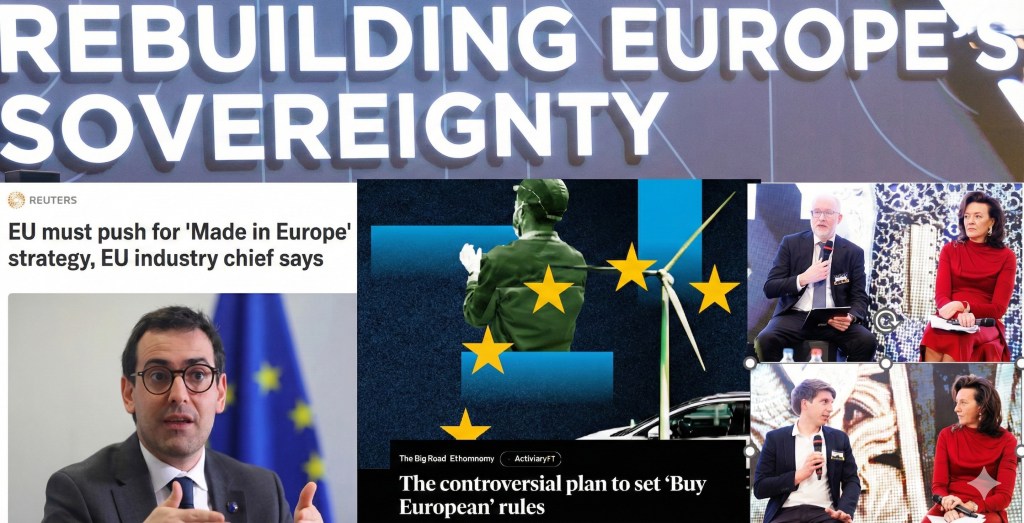
So we need to understand the beast is such that it cannot really be tamed. When I hear terminology like we are taming big tech, I think this is the greatest amount of delusion. We can do some good, we can limit some of the worst behaviour but we are not taming them. They are not knowing that they are being tamed over in California. They don’t believe we are taming them and they don’t care that much. Now, yes if more jurisdictions will expand with regulation and there is a body of countries that are all after them, yeah, it will have an incremental effect but fundamentally I don’t think that this is kind of doing what we are telling ourselves that this is achieving. It’s the reality. So I think the reason this is problematic, particularly for me as a European because of course I come to this as a European, is that – and I’ll conclude – it’s not just a question of power in a commercial sense. It bleeds into something which is a strategic and industrial security problem for Europe because not only do we have a total dependency on these platforms for social networking, for search, for anything else, but if you think about the metal on which these kind of services are sitting, meaning the cloud, the infrastructure, the cables under the ground, these are American assets on which we Europeans depend 80/90% and we have no control over, and if that infrastructure turns hostile in the future, we have an even bigger problem than we know today.
And so I think this is something that the next mandate at the European Commission needs to absolutely tackle, that the world needs to tackle. It is not hopeless. We need to somehow think of digital stacks that are independent of American bigtech. There are countries that are doing that. Brazil has done some, Taiwan has done, India is doing interesting things in that space. Let’s kind of learn from each other and do something a bit more creative because it is not just about commercial power. I conclude on the democracy point. We just had an election in Europe. We haven’t had a catastrophe, it’s true, but there is no question that inside the Commission there is an awareness that there has been interference with election. There has been doppelganger interference from Russia and China. It is at least the kind of current perception, so this stuff is real and we are going to see an American election which is scary to all of us. So I think this is what is really facing us and I think digital enforcement is nice to have but you know, when I hear regulators saying I don’t understand why companies don’t have a view that complying is a badge of honour – hello, hello! I’ll leave it there.



 The “Post-Bubble” Blog